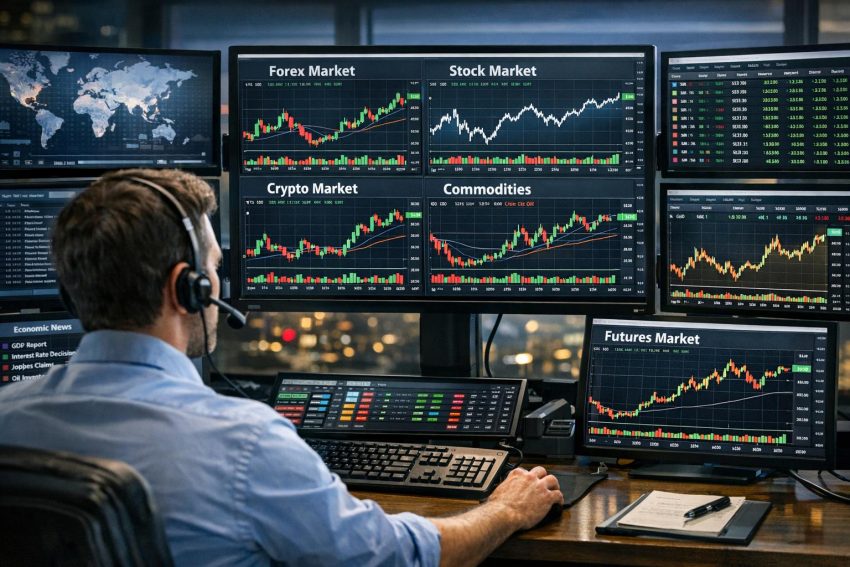
Modern financial markets operate across multiple asset classes, geographic regions, and time zones. Traders often monitor equities, commodities, foreign exchange, derivatives, fixed income instruments, and digital assets simultaneously. This interconnected structure means that price movements in one corner of the market can influence valuations elsewhere within seconds. Attempting to follow these developments manually by switching between brokerage accounts, exchange websites, and data terminals is inefficient and increases the likelihood of oversight. Trading software addresses this challenge by consolidating diverse market data into unified platforms that allow users to observe, analyze, and act across several markets at once. Through real-time data feeds, customizable dashboards, automation, and integrated analytical tools, such systems help traders maintain structured oversight and respond to market movements in an organized manner.
In addition to consolidating information, modern trading software reshapes the workflow of both retail and institutional participants. It brings together pricing, charting, execution, portfolio tracking, and compliance functions that would otherwise exist in isolation. As market participation expands globally and instruments become more complex, the role of centralized technological infrastructure becomes increasingly central to effective monitoring and execution.
Centralized Market Data Aggregation
The primary function of trading software is to aggregate price data from multiple exchanges and asset classes into a single interface. Instead of logging into separate platforms for equities, foreign exchange, commodities, or derivatives, users can monitor all relevant instruments within one application. This centralization reduces the friction associated with switching between systems and limits the operational risks that arise from fragmented oversight.
Data aggregation is typically achieved through a combination of direct exchange connectivity, brokerage infrastructure, and third-party data vendors. Real-time feeds deliver bid and ask quotes, last traded prices, trading volumes, and depth-of-market information. The software standardizes differences in exchange formats and time stamps, presenting uniform charting and order entry panels regardless of the underlying source. This normalization process is essential when combining markets that operate under distinct regulatory frameworks and technical protocols.
Because financial markets operate across time zones, aggregated platforms offer continuous visibility. When equity markets in one region close, currency and commodity markets elsewhere may remain active. Trading software enables seamless transition between sessions, displaying overnight price activity and updating positions as global markets evolve. This continuity is particularly important for participants executing cross-border or cross-asset strategies.
Many platforms also provide comprehensive historical data archives. These datasets extend beyond simple price charts to include intraday bar histories, tick-level data, and volume distributions. With synchronized timelines across asset classes, traders can examine historical correlations, volatility clusters, and lead-lag relationships. Such analysis supports long-term strategic development as well as short-term tactical decisions.
Customizable Dashboards and Workspaces
Effective monitoring of multiple markets depends not only on data availability but also on how that data is structured visually. Trading software addresses this need through highly customizable dashboards. Users can arrange price charts, market depth windows, news panels, economic calendars, portfolio summaries, and order entry modules in configurations aligned with their trading approach.
A currency-focused trader may choose to display several time-frame charts for major pairs alongside commodity benchmarks that influence exchange rates. An equity derivatives specialist might align stock price charts with corresponding options chains and implied volatility graphs. The ability to organize modules freely allows the interface to reflect the logic of a given strategy rather than impose a fixed structure.
Many platforms permit the creation of multiple saved workspaces. Each workspace can contain distinct chart templates, watchlists, and analytical tools. This functionality allows a user to switch from a short-term intraday setup to a longer-term macroeconomic monitoring layout without reconstructing the interface. Saved layouts also ensure that updates or restarts do not disrupt established analytical environments.
Real-time alerts further enhance dashboards. Instead of observing every instrument constantly, traders may configure notifications triggered by price thresholds, percentage changes, volatility bands, or indicator signals. Alerts can be delivered via on-screen pop-ups, audio signals, or mobile notifications. This selective monitoring approach directs attention to conditions that require action while allowing less critical instruments to remain in the background.
Integrated Technical and Fundamental Analysis
Trading decisions across multiple markets often require a blend of technical and fundamental perspectives. Modern trading software integrates both approaches within the same environment, eliminating the need to export data into external charting or research applications.
Technical analysis tools typically include trend-following indicators such as moving averages and average directional index readings, momentum oscillators such as relative strength index and stochastic indicators, and volatility measures like Bollinger Bands or average true range. These indicators can be applied to numerous instruments simultaneously. By comparing signal alignment across markets, traders can identify whether trends are isolated or part of broader market themes.
For instance, a rise in commodity prices may coincide with strength in equities of exporting countries and appreciation in related currencies. By applying identical indicator sets to each instrument, the trader can observe whether momentum characteristics confirm or diverge from one another. This integrated view is difficult to replicate when using separate, unconnected analytical systems.
On the fundamental side, built-in economic calendars display upcoming macroeconomic releases, central bank announcements, and corporate earnings reports. These events frequently influence multiple asset classes simultaneously. If a central bank adjusts interest rates, bond yields, equity indices, and currency valuations may all respond in a coordinated sequence. Trading software aligns price charts with event markers, enabling users to evaluate immediate and delayed market reactions within a single interface.
Some platforms also incorporate estimates, consensus forecasts, and historical comparisons for economic data. When actual releases deviate from expectations, automated highlights draw attention to the divergence. This combination of fundamental context and immediate price response supports structured interpretation rather than impulsive reaction.
Multimarket Watchlists and Cross-Asset Comparison
Watchlists provide a consolidated snapshot of selected instruments across exchanges and asset categories. A single list can include stock indices, exchange-traded funds, government bond futures, major currency pairs, commodity benchmarks, and digital assets. Columns typically display last price, net change, percentage change, accumulated volume, and bid-ask spread.
By aligning data horizontally, watchlists allow users to compare performance at a glance. When volatility intensifies in equities, related movements in safe-haven assets such as government bonds or certain currencies can be evaluated immediately. This near-simultaneous comparison is valuable in macro-driven environments where capital rotates rapidly between asset classes.
Advanced systems supplement basic price columns with calculated metrics such as relative performance rankings, volatility readings, or momentum scores. Sorting by these metrics can reveal which markets lead or lag within a broader trend. Some platforms include correlation matrices that calculate rolling statistical relationships among chosen instruments. Observing strengthening or weakening correlations helps refine diversification approaches or identify emerging concentration risks.
Certain professional platforms extend cross-asset comparison through pair and spread analysis tools. Traders can graph the price difference between correlated instruments, such as two equity indices or a commodity and its related currency. Real-time monitoring of these spreads enables identification of potential convergence or divergence patterns that may support hedging or arbitrage strategies.
Automation and Algorithmic Trading
Monitoring numerous markets manually can strain attention and introduce inconsistency in rule application. Automation features embedded within trading software mitigate these challenges. Through algorithmic trading strategies, users encode predefined entry, exit, and risk-management conditions. Once active, these algorithms scan multiple markets continuously and execute orders when criteria are satisfied.
Automated strategies can range from simple threshold-based systems to more complex multi-factor models that evaluate trend direction, volatility levels, and inter-market relationships simultaneously. For example, a trader might program a strategy that establishes positions in equity index futures only when volatility indices fall below specified ranges while bond yields remain stable. The system monitors each relevant instrument without interruption.
Backtesting engines integrated within many platforms allow historical evaluation of strategy performance. By running simulations on synchronized multi-asset data, traders can examine how rules would have performed under various market conditions. Metrics such as drawdown, profit factor, and risk-adjusted return provide structured assessment before live deployment.
While automation enhances consistency, trading software typically allows manual oversight and intervention. Users can pause algorithms, modify parameters, or override signals if broader market considerations change. This flexible combination of automated scanning and discretionary supervision supports balanced cross-market engagement.
Order Management Across Markets
Monitoring prices is only one dimension of multi-market engagement. Effective participation requires consolidated order management. Trading software centralizes open positions, pending orders, account balances, and margin requirements in a unified dashboard.
This centralized view is particularly valuable for traders holding instruments with varying margin structures, such as leveraged foreign exchange positions alongside equity options and commodity futures. Real-time calculation of aggregate exposure prevents fragmented risk assessment. Profit and loss metrics are updated continuously, both at the instrument level and for the total portfolio.
Advanced platforms incorporate portfolio-level analytics such as value at risk (VaR), scenario analysis, and stress testing. These tools simulate potential losses resulting from hypothetical market shocks, including interest rate adjustments or sudden commodity price declines. Because these calculations draw from synchronized data, they provide a holistic picture of how interconnected exposures may respond to systemic events.
Integrated order routing also enables conditional structures that relate positions across markets. A trader might configure a hedge that triggers automatically if an equity position experiences a defined drawdown, activating a currency or bond trade to offset risk. Centralized order logic simplifies complex strategies involving multiple asset classes.
Real-Time News and Information Feeds
Market prices respond rapidly to new developments. To maintain awareness, trading software often embeds real-time news feeds from established financial information providers. Headlines, analyst commentary, corporate disclosures, and geopolitical updates appear directly within the platform interface.
Users can filter news according to asset class, region, or specific instruments. A trader focused on energy markets may prioritize updates regarding production quotas, inventory data, or regulatory changes. By limiting headlines to relevant categories, platforms help reduce extraneous information while preserving situational awareness.
Some systems apply keyword tagging and event classification to connect news items directly to affected instruments. When a company releases earnings, the relevant stock, sector exchange-traded funds, and options chains may be highlighted automatically. This linking capability connects qualitative information with quantitative price monitoring without requiring manual searches across external sources.
Mobility and Remote Access
Financial markets operate nearly continuously due to overlapping global sessions. To support constant oversight, many trading platforms provide web-based and mobile access built on cloud-based infrastructure. Data, watchlists, chart settings, and open positions synchronize across devices.
Mobile applications allow users to monitor alerts, review charts, and execute trades while away from their primary workstation. Although advanced statistical modelling is typically reserved for desktop environments, mobile connectivity ensures that exposure across multiple markets remains visible. Margin calls, stop-loss activations, or significant price movements generate push notifications that prompt timely review.
Cloud synchronization also supports collaborative environments. Institutional teams may access shared dashboards and coordinated watchlists from different locations. Updates made by one user can be reflected across the group, maintaining consistent situational awareness across regional offices.
Data Visualization and Multi-Chart Layouts
Clear visualization contributes significantly to efficient monitoring. Modern platforms enable multi-chart grids displaying several instruments simultaneously. Time frames can be synchronized so that scrolling or zooming one chart adjusts others accordingly. This feature is useful when assessing whether trends emerge concurrently across markets.
Heat maps provide aggregate visual summaries. In equity markets, sector heat maps illustrate which industries outperform or underperform within an index. In currency markets, strength matrices display relative appreciation or depreciation among major pairs. Such graphical summaries condense extensive datasets into intuitive overviews, allowing rapid identification of outliers.
Time and sales data, order book depth displays, and volume profile charts further expand insight into liquidity distribution and trading intensity. When accessible across multiple exchanges, these tools reveal how order flow in one venue may correspond with movement in related instruments elsewhere.
Risk Controls and Compliance Features
Multi-market exposure inherently involves diversified risk sources. Trading software incorporates embedded controls to manage these complexities. Position limits can be defined per instrument, asset class, or total portfolio. Automated stop-loss and take-profit instructions reduce reliance on manual monitoring during volatile periods.
Conditional order structures may connect instruments within predefined relationships. For example, a protective bond trade can be configured to activate if equity losses exceed a threshold. By encoding risk parameters directly into execution systems, platforms reduce the probability of unmanaged exposure across correlated markets.
For institutional participants, compliance modules maintain detailed audit trails. Every order modification, execution, and cancellation is time-stamped and stored. Integration with reporting systems simplifies regulatory disclosure across jurisdictions. Consolidated records are particularly important for firms operating in multiple exchanges with differing reporting standards.
Application Programming Interfaces (APIs)
Application programming interfaces extend platform functionality beyond standard graphical interfaces. Through APIs, external analytics engines, portfolio management tools, or proprietary risk systems can retrieve real-time data directly from the trading environment. Processed signals can then be transmitted back for order execution.
This bidirectional communication enables complex strategies, including statistical arbitrage across exchanges or latency-sensitive execution algorithms. Institutions may build customized dashboards on top of API connections, tailoring monitoring systems precisely to internal methodologies. APIs also facilitate integration with accounting software and performance reporting tools, aligning trading operations with broader financial management systems.
Efficiency and Cost Considerations
Operating separate systems for each asset class can increase subscription, connectivity, and training expenses. Consolidated trading software may reduce duplication by providing multi-asset coverage under unified licensing structures. While pricing models vary based on data depth and market access, unified platforms often streamline operational budgeting.
Efficiency gains extend beyond subscription costs. Automated synchronization of prices, positions, and performance metrics eliminates manual data entry and reconciliation. Reduced reliance on spreadsheets or disconnected terminals lowers the probability of transcription errors and accelerates daily portfolio reviews.
Limitations and Technical Requirements
Despite broad functionality, trading software does not eliminate technological constraints. Reliable high-speed internet connectivity is necessary to sustain real-time feeds. Hardware performance influences chart rendering speed and data processing capacity, particularly when running multiple algorithmic strategies simultaneously.
Data accuracy depends on feed providers and exchange connectivity. Temporary delays or discrepancies can occur, especially during periods of heightened volatility. Users must understand how their platform sources quotes, whether prices are aggregated or derived from a single venue, and how latency may affect order execution.
Comprehensive platforms may also present learning curves. An extensive suite of tools requires systematic training to ensure proper configuration and interpretation. Many providers offer documentation, simulation accounts, and instructional resources to support informed usage.
Conclusion
Trading software enables coordinated monitoring of multiple financial markets by integrating data aggregation, analytics, execution, and risk management within unified systems. Through customizable dashboards, synchronized multi-chart layouts, real-time alerts, automation modules, and centralized order management, users can maintain visibility across equities, currencies, bonds, commodities, derivatives, and digital assets.
The ability to compare instruments side by side, assess portfolio-wide exposure, interpret macroeconomic developments, and implement predefined strategies enhances operational discipline. Although market uncertainty and external risks remain inherent, structured technological integration improves transparency and efficiency. In increasingly interconnected global markets, the capacity to observe and manage multiple asset classes through consolidated trading software constitutes a foundational component of modern market participation.