
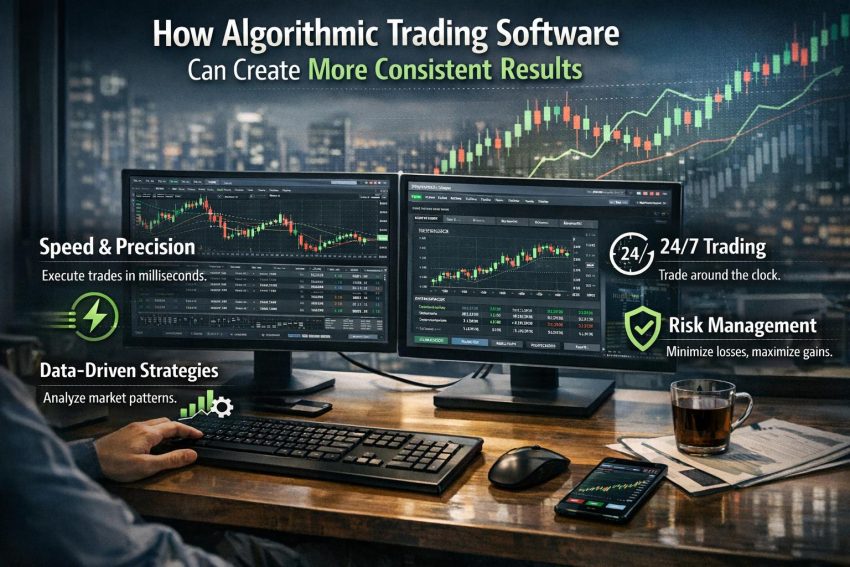
Algorithmic trading software has reshaped how financial markets operate by allowing orders to be executed through predefined rules based on price, volume, timing, and other measurable variables. Rather than relying exclusively on manual decision-making, traders and institutions increasingly use automated systems to generate, validate, and execute trades. One of the central reasons for this adoption is the pursuit of more consistent results.
Consistency in trading does not mean eliminating losses. Instead, it refers to the ability to apply a repeatable process that reduces variability caused by human error, emotional decision-making, and inconsistent execution. Algorithmic systems aim to enforce discipline and structure in environments that are often characterized by volatility and uncertainty. When properly designed, tested, and monitored, algorithmic trading software can contribute to more stable and predictable performance over time.
The Structure of Algorithmic Trading Systems
At its foundation, algorithmic trading relies on predefined rules and mathematical models. These rules are translated into code that monitors market conditions and automatically places orders when certain criteria are met. Conditions may include price thresholds, technical indicators, time-based triggers, statistical relationships, or combinations of multiple signals.
Once deployed, the system operates continuously, scanning markets for qualifying patterns. Because instructions are encoded in software, every qualifying event is handled in the same manner. This removes variability introduced by hesitation, doubt, or inconsistent interpretation of data. The system does not reinterpret its logic mid-session; it applies identical criteria from the first trade to the last.
Most algorithmic frameworks are designed around a structured lifecycle of a trade. The process begins with signal generation, where market data is evaluated against coded rules. If a signal qualifies, the system proceeds to risk evaluation, calculating position size according to predefined exposure limits or portfolio constraints. It then executes the order using programmed routing logic. Once active, the position is monitored continuously against exit conditions such as stop-loss levels, profit targets, trailing stops, or time-based closures. The trade exits automatically when one of these conditions is satisfied.
This end-to-end automation reinforces repeatability. Every component is governed by rules rather than discretion, which reduces performance variability resulting from inconsistent execution choices.
Reducing Emotional Bias
Behavioral finance research has documented how psychological influences affect investment decisions. Fear during drawdowns, overconfidence after profitable trades, and reluctance to accept small losses can distort rational judgment. Even experienced traders are not immune to these cognitive pressures. Minor deviations from trading plans may appear insignificant in isolation, but over time they can materially alter return profiles.
Algorithmic trading software does not experience emotional responses. Once parameters are defined, the software follows instructions precisely. A stop-loss is triggered exactly where it was programmed, not reconsidered at the last moment. A profit target is executed when conditions are met, without hesitation based on speculative expectations. This mechanical discipline prevents emotional overrides from interfering with predefined logic.
Over a sufficiently large sample of trades, this disciplined execution may reduce variability in key performance metrics. The objective is not to increase win rates artificially, but to ensure that actual performance aligns as closely as possible with the tested statistical characteristics of the strategy.
Standardization of Risk Management
Effective risk management underpins sustainable trading performance. In discretionary environments, position sizing and exposure management can fluctuate depending on recent outcomes or market sentiment. A trader may reduce size excessively after a loss or increase exposure beyond intended limits after consecutive wins. Such inconsistency alters the statistical foundation of a strategy.
Algorithmic systems enforce uniform risk parameters at all times. Position sizing formulas based on fixed fractional risk, volatility scaling, or portfolio allocation rules are applied identically to each qualifying signal. If a strategy risks one percent of capital per trade, that percentage remains constant unless deliberately reprogrammed.
Software can also evaluate aggregate exposure across correlated instruments. For example, if multiple signals arise within the same asset class, the system can cap total sector exposure automatically. Additionally, predefined drawdown limits can suspend trading activity temporarily to prevent further capital erosion during adverse conditions. These controls strengthen consistency by limiting discretionary risk deviations.
Execution Precision and Market Access
Execution quality has a measurable impact on trading outcomes. Delayed entries, partial fills, or slippage beyond expectations can reduce realized performance relative to theoretical results. Manual execution inherently introduces time lag between decision and action. In fast-moving markets, even short delays may alter fill prices.
Algorithmic trading systems integrate directly with brokerage infrastructure via application programming interfaces. This connectivity allows orders to be transmitted immediately once signal conditions are confirmed. Reduced latency narrows the gap between intended and executed price levels.
In addition to speed, algorithms can employ structured execution strategies. Methods such as time-weighted average price (TWAP) or volume-weighted average price (VWAP) distribute order flow according to predefined schedules or market participation rates. Smart order routing can scan multiple liquidity venues and select execution paths that minimize transaction cost. For larger participants, algorithms may fragment orders to reduce market impact. These mechanisms enhance the reliability of execution, thereby supporting consistent realized outcomes.
Backtesting and Historical Robustness
Before allocating capital, algorithmic strategies are typically subjected to backtesting. Historical market data is used to simulate how the strategy would have behaved in previous periods. Metrics such as return distribution, maximum drawdown, trade duration, and volatility are derived from this testing phase.
Although historical performance cannot predict future results with certainty, structured testing provides a benchmark for evaluating expected behavior under varying market regimes. Developers can conduct sensitivity analysis by altering parameters slightly to determine whether performance remains stable. If small parameter changes cause significant swings in outcomes, the strategy may lack robustness.
Advanced simulation environments also incorporate transaction costs, bid-ask spreads, and latency assumptions. Monte Carlo resampling techniques may be used to model different trade sequences, helping assess whether results depend excessively on specific historical conditions. This validation process reduces the likelihood that live results will deviate substantially from statistical expectations.
Forward Testing and Live Monitoring
Following historical validation, many practitioners implement forward testing in simulated or limited-capital environments. This stage measures how the algorithm performs using real-time data without full capital exposure. Differences between backtested and forward performance can highlight issues related to slippage, data feed discrepancies, or structural changes in market behavior.
Live monitoring remains essential even after full deployment. Performance metrics are tracked continuously, and deviations from historical norms are analyzed systematically. Rather than reacting impulsively to short-term losses, structured thresholds can trigger formal review procedures. This disciplined oversight preserves process integrity while allowing controlled adjustments when necessary.
Preventing Inconsistent Strategy Switching
One common cause of inconsistent trading is frequent strategy modification. Traders may abandon methods after short-term underperformance, even if the approach was statistically sound over longer horizons. Repeated switching can prevent any single strategy from realizing its expected value.
Algorithmic environments introduce procedural rigor to strategy updates. Modifications typically require code revision, retesting, and parameter verification. This formal workflow reduces the likelihood of immediate reactive changes. Because adjustments involve analytical effort, they are more likely to be based on measured evidence rather than recent outcomes alone.
Maintaining structured evaluation periods encourages patience and adherence to statistically validated methodologies. As a result, performance variability caused by impulsive strategic shifts is reduced.
Data Integration and Quantitative Depth
Financial markets produce extensive data streams including tick-level pricing, order book depth, macroeconomic releases, and derivatives positioning metrics. Processing this information manually in real time can be impractical. Human attention naturally prioritizes certain inputs while neglecting others.
Algorithmic systems can incorporate multi-factor models that evaluate several data categories simultaneously. For example, a strategy might combine momentum indicators, volatility filters, and macroeconomic event constraints within a single decision engine. Each trade decision reflects the full programmed framework rather than selective perception.
This integration enhances analytical consistency. Every signal is evaluated through the same mathematical structure, reducing subjective bias. Quantitative scoring or ranking systems can standardize trade selection when multiple opportunities compete for limited capital allocation.
Continuous Operation Across Markets
Global markets operate across overlapping time zones. Foreign exchange and certain digital asset markets function continuously throughout the week. Human monitoring capacity is limited by fatigue and scheduling constraints.
Algorithmic trading software operates without interruption, subject only to infrastructure stability. It can respond instantly to price movements during overnight sessions or unusual volatility during off-peak hours. Continuous presence ensures that qualifying opportunities are identified according to rule definitions regardless of local time.
This uninterrupted surveillance supports consistent opportunity capture and reduces missed trades that might otherwise distort performance statistics relative to tested expectations.
Objective Performance Measurement
Automated trading environments rely heavily on quantitative metrics. Risk-adjusted measures such as the Sharpe ratio, Sortino ratio, and maximum drawdown are calculated automatically. Trade-level statistics including expectancy, win-loss ratio, and average holding period are monitored in detail.
Because these metrics are derived directly from recorded trades, they provide objective feedback. Structured reporting reduces reliance on memory or anecdotal impressions. Performance reviews can focus on measurable deviations from historical norms rather than on isolated outcomes.
Incremental strategy improvements may be introduced through controlled experimentation. Parameter adjustments are compared using parallel backtests or shadow portfolios. This evidence-based refinement process enhances long-term stability.
Scalability and Portfolio Construction
Algorithmic infrastructure enables simultaneous deployment of multiple strategies across numerous instruments. A diversified portfolio may contain models based on trend-following, mean reversion, statistical arbitrage, or event-driven principles. Each component can operate independently while sharing centralized risk controls.
Diversification reduces concentration risk. When strategies respond differently to market regimes, combined performance may exhibit smoother return patterns. Allocation algorithms can rebalance exposures periodically or adjust weights in response to volatility changes. These reallocations occur systematically rather than discretionarily.
Scalability also extends to trade frequency. High-frequency models, medium-term swing systems, and longer-term position strategies can coexist in structured layers, each governed by its own execution and risk parameters.
Transparency, Logging, and Audit Trails
Every algorithmic action can be recorded in detailed logs. Entries often include timestamp, signal rationale, order parameters, execution confirmation, and system status indicators. This documentation provides a comprehensive audit trail.
When irregularities occur, logs enable precise investigation. Analysts can determine whether discrepancies arose from market gaps, connectivity interruptions, or coding faults. Such traceability strengthens accountability and supports systematic improvement.
Transparent reporting also facilitates regulatory compliance and internal governance. Documented controls and verifiable behavior enhance reliability in institutional environments.
Infrastructure and Operational Stability
Consistency depends not only on strategy logic but also on operational reliability. Stable servers, redundant internet connections, and secure data feeds are fundamental components. Latency management becomes particularly relevant for strategies sensitive to short-term price movement.
Many professional implementations employ geographically distributed data centers or cloud-based redundancy. Backup systems may include automatic failover protocols that maintain trading continuity if a primary server encounters disruption. These measures reduce operational variance that could otherwise affect performance.
Regulatory Framework and Safeguards
Regulators in multiple jurisdictions require algorithmic trading participants to maintain risk controls such as maximum order size limits, kill switches, and real-time monitoring mechanisms. These safeguards are designed to prevent disorderly market activity and limit unintended exposure.
Compliance obligations encourage structured documentation and testing procedures. Mandatory validations and stress tests reinforce disciplined system architecture. Regulatory oversight therefore complements internal controls, indirectly contributing to consistent operational standards.
Long-Term Statistical Expectation
Algorithmic trading is fundamentally grounded in probability. Even robust strategies experience sequences of losses due to random distribution of outcomes. Consistency should therefore be evaluated across extensive trade samples rather than short intervals.
The purpose of automation is to apply a positive statistical expectancy repeatedly without deviation. By maintaining identical entry, exit, and risk rules across hundreds or thousands of trades, the system seeks to align realized performance with modeled projections. Variability may still occur due to changing market dynamics, but structural discipline reduces randomness introduced by human inconsistency.
Ongoing Adaptation and Review
Markets evolve as liquidity conditions, participant behavior, and macroeconomic structures shift. Sustained consistency requires periodic reassessment of model assumptions. Scheduled reviews, parameter stability checks, and out-of-sample testing help confirm that strategies remain relevant.
Adaptation should be systematic. Rather than altering rules in response to isolated losses, developers analyze longer-term performance distributions. Adjustments are tested formally before integration into live systems. This measured process preserves the benefits of automation while acknowledging that static models may degrade over time.
Conclusion
Algorithmic trading software establishes a structured framework for pursuing consistent results in financial markets. Through rule-based execution, emotional neutrality, standardized risk controls, precise market access, and comprehensive data analysis, these systems address many variables that historically produced inconsistent discretionary outcomes.
However, stability is contingent upon careful design, realistic testing, reliable infrastructure, and disciplined oversight. Automation does not eliminate risk, but it can reduce avoidable variability caused by human inconsistency. When applied with rigorous methodology and ongoing evaluation, algorithmic trading software offers a systematic approach to achieving repeatable and statistically grounded performance over extended periods.