
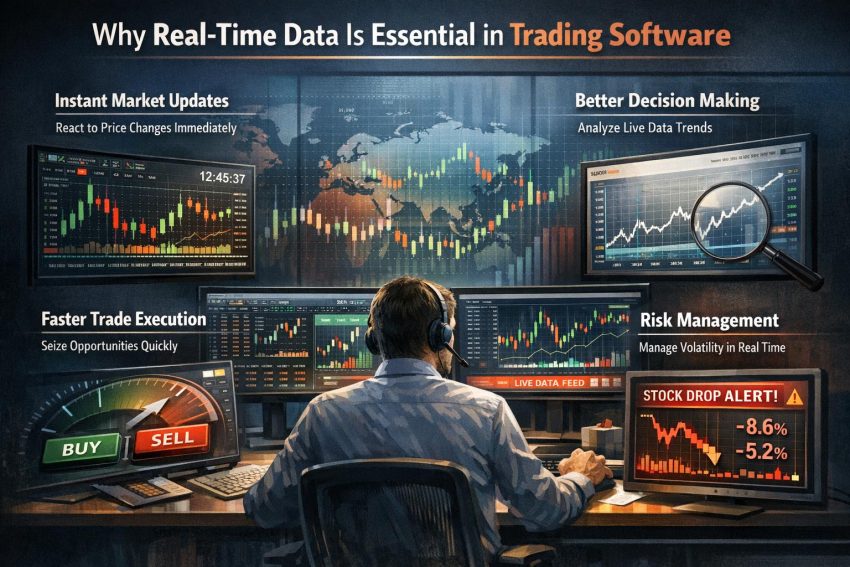
Real-time data has become a foundational component of modern trading software. Financial markets operate at high speed, with prices changing in fractions of a second across equities, commodities, foreign exchange, derivatives, and digital assets. In this environment, the accuracy, timeliness, and reliability of data determine how effectively trading platforms can support decision-making. Real-time data ensures that traders, institutions, and automated systems operate using the most current market information available. Without it, pricing discrepancies, delayed execution, and increased risk exposure can significantly reduce performance and increase operational uncertainty.
The evolution from floor-based trading to fully electronic markets has intensified the reliance on immediate information flows. In earlier decades, price dissemination occurred through human intermediaries, printed reports, or periodic updates. Today, trading platforms process continuous digital streams originating from multiple venues simultaneously. This structural shift has elevated real-time data from a supplementary feature to a core infrastructure requirement embedded deeply within brokerage systems, order management platforms, and portfolio analytics tools.
The Nature of Real-Time Data in Financial Markets
Real-time data refers to market information delivered with minimal latency from exchanges or liquidity providers to trading platforms. This includes bid and ask prices, last traded prices, trading volume, order book depth, trade timestamps, and market status indicators. For derivatives and structured products, it may also include implied volatility, Greeks, and settlement data.
Modern financial markets generate large volumes of information continuously during trading sessions. Each price movement reflects supply and demand interactions occurring across electronic order books. Trading software must ingest, process, and display this information immediately to allow accurate trade execution and risk assessment. The frequency of updates varies by asset class and venue, but in highly liquid markets such as major currency pairs or benchmark equity indices, updates can occur hundreds or thousands of times per second.
The difference between real-time data and delayed data can be significant even when the delay is only a few seconds. In volatile conditions, price swings can make historical data obsolete almost instantly. Therefore, real-time feeds are not simply a convenience but an operational requirement for active market participants. Delayed feeds may still serve research or educational purposes, but they are unsuited for precise order placement or intraday risk management.
In addition to pricing information, real-time feeds increasingly incorporate auxiliary data such as news releases, corporate actions, and macroeconomic indicators. Integrated data environments allow trading platforms to correlate price movements with events as they unfold. This convergence of structured price data and event-driven information enhances contextual awareness across trading desks.
Latency and Execution Quality
Latency represents the time between when a market event occurs and when it is received and processed by trading software. In high-frequency and algorithmic trading, latency is measured in milliseconds or microseconds. Even for retail traders, latency affects price accuracy at the moment of order placement. Execution quality depends directly on the alignment between displayed quotes and executable liquidity.
When a trader submits an order, several processes occur in sequence. The trading platform transmits the order to a broker or directly to an exchange, the order is matched against available liquidity, and a confirmation is returned. Each stage can introduce delay. If the underlying market data used to inform that order is not current, the probability of execution at an unintended price increases. This dynamic is particularly evident in fast-moving markets following economic releases.
Low-latency data feeds enable platforms to synchronize with exchange servers and liquidity pools efficiently. This synchronization reduces the likelihood of requotes or rejected orders, particularly during periods of rapid market movement. Institutional trading environments frequently deploy optimized network routing and hardware acceleration techniques to reduce transmission times. Co-location of servers within or near exchange data centers minimizes physical distance, thereby reducing communication delay at the infrastructure level.
Execution quality is also influenced by how platforms prioritize and queue incoming data packets. Efficient message handling ensures that price updates are processed in correct chronological order. Even minor sequencing inconsistencies can distort the visible order book and impact execution decisions for short-duration strategies.
Price Discovery and Market Transparency
Financial markets rely on price discovery, the process by which supply and demand determine asset values. Real-time data contributes directly to transparent price discovery by broadcasting current bids, asks, and executed trades. Trading software aggregates these feeds and presents coherent price streams to end users.
Order book visibility provides insight into liquidity conditions at different price levels. Traders assessing market depth may adjust order sizes or execution tactics depending on visible supply and demand. Real-time transparency reduces informational asymmetry by ensuring that participants base decisions on consistent and current information streams.
Without current data, traders operate with partial or distorted information. Outdated order book data may obscure large resting orders or sudden liquidity withdrawals. Real-time transparency allows participants to evaluate market depth and identify potential price momentum or areas of structural support and resistance.
Market transparency also supports regulatory oversight. Exchanges and regulators monitor trading activity in real time to detect unusual patterns, potential manipulation, or systemic risk. Trading platforms that integrate real-time data feeds can implement surveillance mechanisms and compliance checks with greater accuracy. Continuous visibility facilitates the identification of irregular order placements, excessive concentration, or abrupt liquidity changes that may affect market stability.
Algorithmic Trading and Automation
Algorithmic trading systems depend entirely on accurate and immediate data inputs. These systems apply predefined rules or machine learning models to execute trades automatically when certain criteria are met. If the input data lags behind actual market conditions, algorithmic decisions become flawed.
Automated trading strategies often react to micro price fluctuations, statistical relationships, or order book imbalances. For example, market-making algorithms continuously update bid and ask quotes based on live volatility and spread conditions. In statistical arbitrage, small pricing deviations between correlated assets can dissipate quickly. Real-time data ensures that algorithms identify actionable discrepancies before they converge.
Machine learning applications within trading software extend beyond simple rule-based triggers. Adaptive systems ingest streaming data to recalibrate parameters continuously. Volatility estimates, liquidity metrics, and short-term trend indicators can update dynamically in response to new information. Without uninterrupted real-time inputs, adaptive models lose responsiveness and may generate outdated signals.
Automation also requires consistent timestamp accuracy. Precise time synchronization across servers ensures that event sequencing remains reliable. Discrepancies in timekeeping can introduce distortions in backtesting comparisons and live deployment, particularly in strategies with short intended holding periods.
Risk Management and Portfolio Monitoring
Effective risk management relies on constant visibility into asset prices and exposures. Trading software calculates metrics such as value at risk (VaR), expected shortfall, margin requirements, unrealized profit and loss, and leverage ratios using live price inputs. Without real-time updates, these metrics quickly become unreliable and may fail to reflect actual exposure.
Market volatility can alter portfolio risk profiles within minutes. Leveraged positions are especially sensitive to intraday movements. Real-time data enables automated recalculation of margin balances and collateral requirements, helping brokers enforce prudent risk controls. Systems can trigger position reductions or liquidation protocols when predefined thresholds are exceeded.
Institutional trading desks integrate risk systems with multiple exchanges and asset classes. Consolidated dashboards depend on synchronized data feeds to reflect true aggregate exposure. Inconsistent timing between feeds may create gaps in exposure assessment, particularly for cross-asset hedging strategies where offsetting positions must be evaluated concurrently.
Stress testing frameworks also benefit from immediate data inputs. While scenario analysis often relies on hypothetical shocks, baseline portfolio values must reflect current market conditions before simulations are applied. Accurate inputs strengthen the reliability of forward-looking risk projections.
High-Frequency Trading and Competitive Dynamics
High-frequency trading (HFT) firms operate on extremely short time horizons, executing large volumes of trades within milliseconds. For these participants, access to ultra-low-latency market data is fundamental. Small differences in data receipt times can influence queue positioning within exchange matching engines.
Competitive dynamics in modern markets frequently revolve around speed optimization. Exchanges offer proprietary data feeds delivering depth-of-book information with minimal delay. Trading software targeting professional users must process these feeds at high throughput while preserving deterministic performance standards.
Although HFT represents a specialized segment, its infrastructure innovations often influence broader market architecture. Improvements in feed handling, network optimization, and redundancy developed for high-frequency strategies subsequently enhance reliability for other participants. Real-time data ecosystems therefore evolve through competitive technological advancement.
Impact on Retail Trading Platforms
Retail trading has expanded alongside improvements in mobile computing and internet connectivity. Individuals now access multi-asset trading platforms from personal devices. For these applications, reliable real-time data maintains execution fairness and platform credibility.
Retail users may not execute high volumes, yet they depend on accurate streaming quotes when placing trades. Sudden price changes during earnings announcements or macroeconomic releases emphasize the need for immediate updates. Visible discrepancies between quoted and executed prices can undermine trust in brokerage systems.
Modern platforms integrate streaming charting modules, customizable technical indicators, and real-time analytics. Indicators such as moving averages, relative strength index (RSI), and volume-weighted average price (VWAP) update continuously as new data arrives. The computational engines supporting these functions must recalculate efficiently to avoid interface lag or graphical distortion.
User interface design also influences the presentation of real-time information. Efficient compression algorithms ensure that high-frequency data streams can be transmitted to mobile devices without excessive bandwidth consumption. Data caching strategies maintain continuity during temporary connectivity interruptions.
Data Integration Across Asset Classes
Contemporary investment strategies often cover equities, fixed income instruments, commodities, foreign exchange, and digital assets. Each asset class trades on distinct venues with unique microstructures and reporting conventions. Trading software must harmonize these heterogeneous real-time feeds into a consistent analytical framework.
Data normalization transforms disparate message formats into standardized internal representations. Differences in tick size, contract specifications, and trading hours require systematic alignment. Without uniform normalization, cross-asset comparisons may produce erroneous analytics.
Cross-market arbitrage, pairs trading, and delta hedging strategies depend on synchronized information across instruments. A discrepancy between derivative prices and underlying assets due to feed delay can impair hedge ratios and introduce unintended directional exposure. Reliable integration mitigates this risk by ensuring concurrency in price updates.
System Architecture and Scalability
Handling real-time market data necessitates resilient system architecture. Trading platforms rely on distributed computing environments capable of processing large data volumes concurrently. Message queues, in-memory databases, and parallel processing engines distribute computational load to avoid bottlenecks.
Scalability becomes particularly important during periods of elevated trading activity. Opening auctions, index rebalancing events, or significant policy announcements may trigger sharp increases in message traffic. Systems must accommodate these surges while preserving low latency and data integrity.
Redundancy mechanisms contribute to operational continuity. Failover servers, geographically distributed data centers, and replicated data streams help maintain functionality during hardware or network disruptions. Hybrid deployment models combining on-premises infrastructure with optimized cloud resources provide flexibility while retaining control over latency-sensitive components.
Compliance and Regulatory Considerations
Financial regulations impose strict requirements regarding order tracking, timestamp precision, and transaction reporting. Real-time data integration ensures that each order event is accurately recorded at the moment it occurs. High-resolution timestamps support detailed audit trails.
Best execution standards in many jurisdictions require firms to demonstrate that client orders receive favorable terms relative to prevailing market conditions. Access to comprehensive real-time data allows brokers to compare execution venues and document compliance efforts.
Surveillance frameworks rely on immediate data streams to detect irregular trading patterns. Analytical tools monitor live flows for indications of manipulative practices such as spoofing or layering. Continuous observation enhances market integrity and supports enforcement actions when necessary.
Market Events and Volatility Management
Periods of elevated volatility illustrate the operational value of immediate information. During macroeconomic announcements, corporate disclosures, or geopolitical developments, price adjustments occur rapidly across interconnected markets. Trading platforms equipped with real-time feeds can update margin calculations, risk metrics, and trading halts without delay.
Circuit breakers and volatility controls depend on live pricing thresholds. Automated mechanisms suspend trading or adjust collateral requirements based on continuously monitored parameters. Without reliable real-time inputs, protective controls may activate too late or fail to reflect prevailing conditions accurately.
Portfolio managers responding to rapid market shifts require synchronized visibility across positions. Immediate data supports hedging adjustments, liquidity assessments, and exposure reduction strategies in compressed timeframes.
Data Accuracy and Integrity
While speed is essential, data accuracy remains equally critical. Inaccurate price dissemination can lead to erroneous order placements or flawed portfolio valuations. Trading systems implement validation checks that compare incoming data against reference thresholds to identify anomalies.
Redundant data sources strengthen reliability. If one provider experiences disruption, alternative feeds can maintain continuity. Cross-verification between independent sources reduces the probability of propagating incorrect prices through trading algorithms or client interfaces.
Cybersecurity protections safeguard data streams from unauthorized interference. Encryption protocols, secure authentication, and network monitoring protect both proprietary strategies and client transactions. Operational resilience extends beyond speed to encompass integrity and continuity.
Strategic Decision-Making and Competitive Advantage
Access to comprehensive real-time data enhances strategic planning. Portfolio allocation shifts, sector rotations, and hedging adjustments rely on timely interpretation of market signals. Analytical models deliver more accurate insights when built upon current information rather than delayed snapshots.
Firms investing in advanced data infrastructure often experience measurable improvements in execution efficiency and transaction cost management. Reduced slippage, optimized routing, and accurate spread analysis contribute incrementally to performance outcomes over extended horizons.
As financial markets continue to digitize and integrate globally, the competitive landscape increasingly reflects technological capability. Real-time data functions as the informational foundation supporting innovation in analytics, automation, and cross-market strategy development.
Conclusion
Real-time data is integral to the structure and reliability of modern trading software. It underpins precise execution, transparent price discovery, automated strategy deployment, and comprehensive risk oversight. From retail brokerage platforms to institutional trading environments and high-frequency firms, continuous access to immediate market information supports operational stability and informed decision-making.
Ongoing advancements in network infrastructure, data processing architecture, and cybersecurity will continue shaping how trading systems manage and disseminate information. In increasingly interconnected and high-speed markets, platforms that maintain accurate, secure, and scalable real-time data frameworks remain better equipped to meet regulatory standards, manage volatility, and sustain competitive performance.