
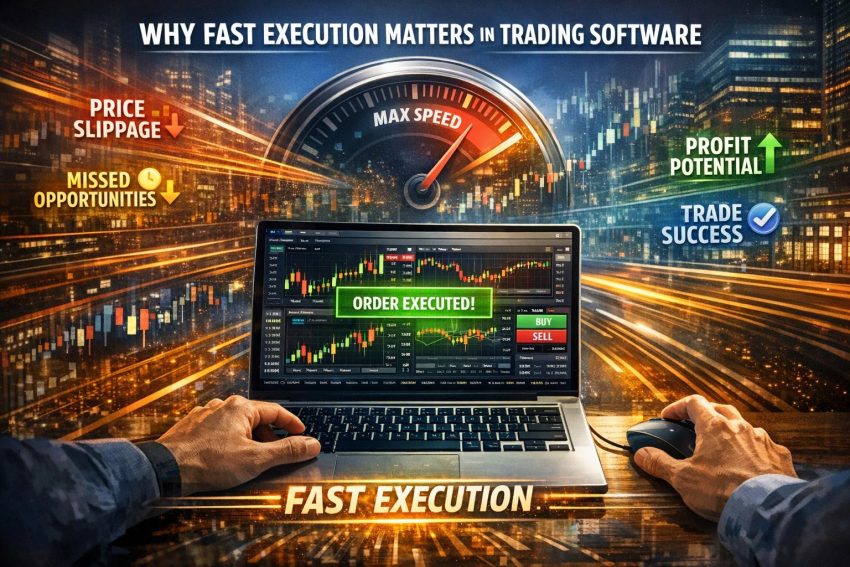
Fast execution is a foundational requirement in modern trading software. Financial markets operate through electronic systems where orders are matched in fractions of a second. In this environment, the speed at which a trading platform processes market data, transmits orders, and receives confirmations directly affects performance outcomes. While trading strategies vary in complexity and time horizon, execution speed plays a measurable role in pricing accuracy, risk management, transaction cost control, and overall system reliability.
As markets have become increasingly automated, competition among participants has shifted toward technological efficiency. Institutional firms, proprietary trading desks, hedge funds, and increasingly retail traders rely on software infrastructure to interact with exchanges. When milliseconds—or even microseconds—separate profitable trades from losses, execution quality becomes a decisive factor. Technological capability now forms a core layer of market participation rather than a secondary support function.
The Mechanics of Trade Execution
Trade execution refers to the process that begins when a trader or algorithm sends an order and ends when the order is filled or confirmed. This workflow involves multiple components: the trading interface, order management system, network transmission channels, broker risk filters, exchange gateways, matching engines, clearing notifications, and confirmation systems. Each step introduces potential delay, commonly referred to as latency.
Latency measures the time difference between order initiation and execution response. In high-frequency environments, latency is calculated in microseconds. In standard electronic trading contexts, it is typically measured in milliseconds. Regardless of measurement scale, latency directly determines how accurately an order captures the intended market price.
Once an order leaves the trader’s interface, it travels through internal processing layers. These layers validate order parameters, confirm account balances, verify margin requirements, and apply pre-trade risk checks. The order is then serialized into a network packet and routed to an exchange gateway. Upon arrival, the exchange matching engine processes it relative to the current order book state. After matching, acknowledgments travel back through the same or similar channels. Each propagation step adds measurable time.
Even minimal latency variations can influence execution results when measured across thousands of interactions. For active strategies, very small pricing differentials multiply over time. High-performance trading software optimizes each processing step to reduce computational overhead, streamline routing, and shorten transmission intervals.
Latency Categories and Measurement
Latency is not a single metric but a composite of several components. Network latency refers to the time required for data to travel between systems. Processing latency arises from internal computations within trading software. Exchange latency reflects the time taken by exchange infrastructure to acknowledge and match orders. Understanding these layers allows firms to identify improvement opportunities.
Precise timestamping is central to latency measurement. Systems often synchronize clocks using high-precision time protocols to achieve nanosecond-level accuracy. Such synchronization supports regulatory compliance, post-trade analysis, and infrastructure benchmarking.
Round-trip time—the full duration from order submission to confirmation—remains a critical indicator. However, more granular measurements, such as gateway-to-matching-engine time or strategy-decision-to-wire time, offer deeper diagnostic insight. Firms that monitor only average latency may overlook spikes that occur sporadically but materially impact execution consistency.
Price Sensitivity in Electronic Markets
Modern electronic markets update prices continuously based on order book dynamics. Bid and ask quotes can change many times per second in actively traded instruments such as index futures, major currency pairs, or high-volume equities. When software operates with measurable delay, traders risk acting on information that is no longer current at the moment of execution.
The relationship between price movement and time delay becomes more significant during volatile intervals. Market-moving announcements, macroeconomic releases, or large institutional flows can create rapid transitions in liquidity. Under such conditions, the difference between a five-millisecond and a fifty-millisecond response time may determine fill quality.
Fast execution software integrates high-speed data feeds with optimized in-memory processing. Efficient architectures avoid unnecessary copying of data packets, reduce context switching between system threads, and prioritize immediate reaction to market events. The objective is not to predict direction but to ensure that order placement reflects contemporaneous market conditions.
Impact on High-Frequency and Algorithmic Trading
Algorithmic trading systems operate according to predefined logic that responds to structured inputs. In many cases, the trading signal itself is short-lived. Statistical arbitrage, order book imbalance strategies, and latency arbitrage models often capture inefficiencies that disappear quickly once detected by multiple participants.
High-frequency trading (HFT) exemplifies the most latency-sensitive segment of the market. Firms operating in this space invest in proximity hosting within exchange data centers, specialized network cards, kernel bypass networking, and hardware acceleration using field-programmable gate arrays. The objective is to minimize the interval between data receipt, decision generation, and order placement.
Queue priority remains a central structural element. In price-time priority systems, orders at a given price are executed in the sequence they were received. Faster arrival confers a structural advantage by positioning orders closer to the front of the queue. Over repeated trading cycles, consistent queue advantage can translate into improved fill probability and reduced exposure to adverse price selection.
Although not all market participants operate at microsecond speed, the presence of highly optimized competitors increases the execution threshold across markets. Strategies that ignore latency constraints may experience systematically inferior outcomes.
Execution Speed and Slippage Control
Slippage describes the difference between the expected price of a trade and the actual executed price. It occurs when prices change before an order reaches the matching engine or when liquidity at the selected level is insufficient. Slippage may be positive or negative, but in competitive markets it more commonly reduces price efficiency for slower participants.
Fast execution mitigates slippage by narrowing the time gap between price observation and order arrival. If a trading system identifies a favorable bid-ask spread and transmits immediately, the probability that those quotes remain valid upon arrival increases. Delays widen the opportunity for price drift.
Routing efficiency also contributes to slippage reduction. In markets with multiple trading venues, smart order routing systems evaluate pricing and available depth across exchanges. High-performance routers process venue data concurrently and maintain persistent connections, avoiding repeated handshake delays.
In decentralized markets such as foreign exchange or digital asset exchanges, liquidity aggregation engines play a similar role. Their ability to update composite order books rapidly influences the consistency of execution prices. While slippage remains unavoidable during significant market shifts, optimized speed converts random variance into more predictable cost behavior.
Risk Management Implications
Execution speed significantly influences risk control mechanisms. Protective orders, including stop-loss and trailing stops, must activate promptly when trigger conditions are met. If internal processing lags, market exposure may exceed planned thresholds.
In leveraged products, timely liquidation processes protect both traders and counterparties. Margin systems continuously compute exposure relative to maintenance requirements. Delays in liquidation logic during high-volatility intervals can amplify systemic stress. Efficient platforms calculate margin obligations in near real time to maintain orderly risk reduction.
Institutional trading systems integrate pre-trade risk checks that verify compliance with internal mandates and regulatory rules. These checks include notional exposure limits, instrument restrictions, and position concentration controls. Architectural design must ensure that risk validation occurs without introducing excessive bottlenecks into order flow pipelines.
Derivatives trading adds computational complexity. Portfolio risk metrics such as delta, gamma, and value-at-risk require recalculation when underlying prices shift. Systems optimized for high-throughput computation allow traders to rebalance positions before exposure compounds.
Infrastructure and Architectural Design
Execution performance begins with architectural choices. Event-driven system design processes incoming market data as discrete events, reducing idle polling cycles. This approach enables immediate reaction to new information without waiting for scheduled refresh intervals.
Low-level programming languages are often chosen for core execution engines due to consistent memory control and predictable timing behavior. Minimizing abstraction layers reduces instruction overhead and limits unpredictable pauses. Custom memory pools and object reuse patterns further stabilize latency profiles.
Network topology contributes measurably to performance. Physical distance affects transmission time because data travels at a finite speed through fiber-optic cables. Co-location services place trading servers within or near exchange facilities, reducing geographic delay. Optimized routing paths and high-capacity bandwidth further improve consistency.
Hardware-level enhancements, including network interface cards that bypass kernel networking stacks, decrease packet processing intervals. While not all participants require such solutions, the foundational principle remains applicable at any scale: removing unnecessary processing layers reduces aggregate latency.
Order Routing Efficiency
Order routing determines where and how trades are executed. Efficient routing engines analyze pricing, fee structures, order type compatibility, and historical execution performance across venues. The objective is to maximize fill probability and price quality.
Persistent low-latency connections to exchanges reduce initialization delays. Parallel evaluation of venue data prevents sequential processing bottlenecks. Robust routing logic also adapts dynamically to liquidity shifts, temporarily prioritizing venues demonstrating faster acknowledgments.
Retail platforms increasingly incorporate similar routing methodologies, though infrastructure depth may differ. For both institutional and individual participants, responsiveness in routing decisions influences measurable execution quality.
Market Microstructure Considerations
Electronic order books operate under specific matching rules. Price-time priority rewards early arrival at a given price, while pro-rata systems allocate fills proportionally by size. In both structures, execution timing affects participation probability.
Liquidity availability fluctuates continuously. In thinner markets, displayed depth at a certain price may disappear within milliseconds. Traders using slower systems may observe liquidity but fail to secure execution. Partial fills introduce complexity by leaving residual positions exposed to further price movement.
Market makers continuously update quotes to manage inventory risk. Interaction speed determines whether a participant trades against the displayed quote before it moves. The combination of timing precision and order type selection affects realized transaction costs.
Data Processing and Real-Time Analytics
Effective execution depends on efficient data pipelines. Incoming market data must be parsed, normalized, and distributed to strategy components without delay. Systems relying heavily on disk input/output or excessive inter-process communication may introduce avoidable latency.
Low-latency data pipelines favor memory-based computation, minimizing serialization overhead. Multithreaded architectures separate data ingestion from analytical computation and order transmission. Carefully tuned thread affinity prevents unnecessary context switching.
Predictable garbage collection and memory management are critical in certain runtime environments. Latency spikes caused by memory cleanup cycles can disrupt algorithmic timing. Monitoring tools track such anomalies to support continuous optimization.
Volatility Events and Stress Conditions
Execution infrastructure must withstand transient spikes in order traffic. During macroeconomic announcements or abrupt geopolitical developments, trading volume can surge dramatically. Systems lacking scalability may encounter message queue backlogs or delayed confirmations.
Resilient architectures incorporate redundancy, distributed load handling, and automated failover. Stress testing under simulated high-volume scenarios helps firms understand performance ceilings. Throughput capacity, rather than average latency alone, determines stability during stress periods.
Even when exchange systems themselves slow under congestion, internally optimized software prevents compounding delays within the trading firm’s own environment.
Competitive Dynamics and Cost Structure
Execution efficiency produces cumulative financial effects. Marginal improvements in average fill price or reduced rejection rates can significantly alter aggregate profitability across high trade volumes. Firms evaluate technology investment decisions through cost-benefit analysis, examining whether further latency reductions justify infrastructure expenditure.
Execution quality metrics such as effective spread, realized spread, and order-to-fill ratio provide quantitative evaluation tools. Continuous benchmarking ensures that systems remain aligned with evolving market standards.
Retail Trading Considerations
Retail participants, although less latency-sensitive than high-frequency firms, still depend on consistent execution. Platform responsiveness, stable connectivity, and timely order confirmation support disciplined trade management.
Cloud-based deployment models allow brokers to distribute server resources geographically, reducing regional disparities in execution speed. User interface efficiency also influences timing; delays between user input and order dispatch may introduce unintended exposure.
For longer-term traders, speed consistency contributes to statistical dependability. A strategy tested under specific assumptions about execution cost and timing requires comparable real-world infrastructure to maintain validity.
Regulatory and Compliance Dimensions
Regulatory frameworks emphasize fair access and best execution standards. Brokers must demonstrate that routing decisions aim to secure favorable outcomes relative to prevailing market conditions. Accurate timestamping and detailed audit logs support this requirement.
Clock synchronization protocols ensure chronological consistency across distributed systems. Regulators may require reporting precision aligned with defined microsecond or millisecond thresholds. Failure to maintain synchronized systems can result in reporting discrepancies.
Balancing high-speed processing with comprehensive auditability represents a core design consideration. Efficient systems integrate compliance monitoring without obstructing order flow efficiency.
Balancing Speed and Reliability
Execution performance must coexist with operational stability. Systems optimized exclusively for raw speed may neglect safeguards that prevent erroneous trades. Robust validation, circuit breakers, and fail-safe conditions protect participants from unintended consequences.
Deterministic performance refers to predictable latency under varying workload conditions. For many trading strategies, consistent five-millisecond execution is preferable to variable performance fluctuating between one and twenty milliseconds. Predictability supports reliable modeling of transaction cost assumptions.
Comprehensive testing methodologies—covering unit validation, integration workflows, regression analysis, and latency profiling—ensure that enhancements do not degrade reliability. Controlled rollout processes mitigate operational risk during upgrades.
Conclusion
Fast execution in trading software represents a structural requirement shaped by electronic market architecture. From reducing slippage and strengthening queue position to enhancing risk enforcement and supporting competitive pricing, execution speed contributes directly to measurable trading outcomes.
Advancements in automation, data processing, and infrastructure engineering continue to compress acceptable latency thresholds. Participants at every level, from institutional trading desks to retail platforms, rely on optimized software environments to maintain pricing accuracy and operational continuity.
In markets defined by continuous price discovery and immediate order matching, execution timing influences both opportunity capture and cost control. When designed with attention to reliability, transparency, and regulatory standards, high-performance execution systems form a central pillar of effective modern trading operations.