
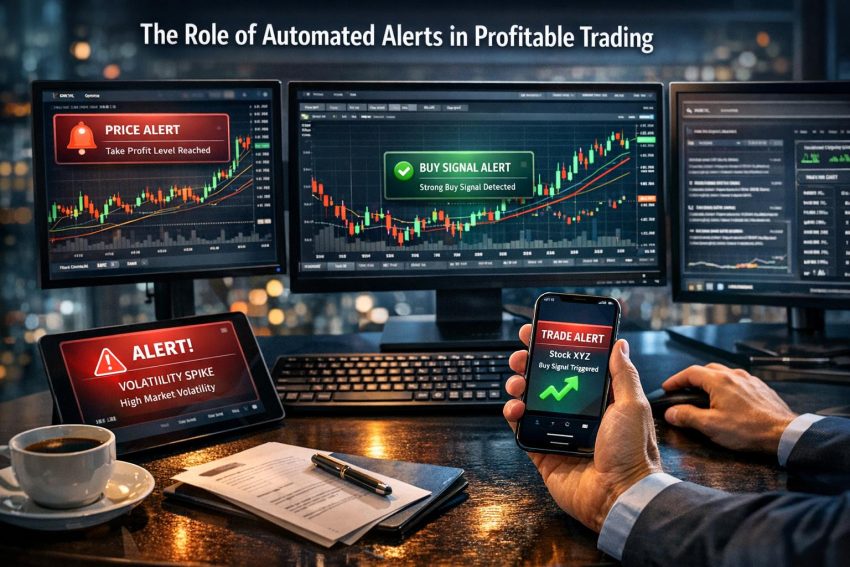
The use of automated alerts has become a central feature of modern financial markets. As trading environments expand in scope and operate continuously across global time zones, participants face the challenge of monitoring assets that can fluctuate at any hour. Equity markets, foreign exchange pairs, commodities, cryptocurrencies, fixed income instruments, and derivative contracts each respond to distinct drivers, often simultaneously. In this environment, constant manual monitoring is neither efficient nor realistic. Automated alerts address this challenge by functioning as predefined triggers that notify traders when specific market conditions occur.
These conditions may include price thresholds, percentage movements, technical indicator crossovers, unusual volume activity, or scheduled macroeconomic data releases. Once activated, alerts deliver notifications in real time through trading platforms, email, mobile applications, or integrated messaging systems. In profitable trading, where timing and discipline influence long-term outcomes, automated alerts serve as a structured decision-support tool rather than a replacement for analysis or strategic reasoning.
The Mechanics of Automated Alerts
At their core, automated alerts rely on algorithmic monitoring of live and historical market data. Brokerage platforms maintain connections to liquidity providers and exchanges, receiving continuous streams of bid and ask prices, trade confirmations, and order book updates. The system compares incoming data to predefined criteria entered by the trader. When market observations match or exceed those criteria, a notification is triggered.
For example, a trader may define an alert condition such as a stock reaching a specific price level, a currency pair moving a certain percentage within a trading session, or a technical oscillator crossing a defined boundary. The system checks these conditions against real-time inputs. Once the parameters are satisfied, the notification is distributed using the trader’s chosen communication channel.
The speed of detection is one of the most important attributes of automated alerts. In active markets, price levels may be reached and surpassed in seconds. A trader monitoring multiple instruments manually may not respond with the same immediacy as an automated system. By continuously evaluating predefined rules without fatigue or distraction, alert systems enhance the probability that key moments are identified when they occur.
Another mechanical advantage lies in objectivity. Automated alerts do not interpret market meaning; they simply evaluate whether conditions match preset instructions. This reduces the risk of subjective filtering that can arise when traders convince themselves that a threshold is “almost reached” or “not quite significant.” The system executes the monitoring function strictly according to programmed inputs.
Improving Market Timing
In trading, execution timing frequently influences profitability. Entering too early may expose the trader to unnecessary volatility, while entering too late may reduce the reward-to-risk ratio. Automated alerts narrow the gap between market development and trader awareness. Instead of discovering a breakout after it has extended significantly, traders can be notified at the moment a predefined threshold is touched or breached.
Support and resistance levels illustrate this function clearly. Technical traders often identify zones where price has historically reversed or consolidated. Monitoring these areas manually across numerous assets can consume substantial attention. An alert positioned at or near these levels allows the trader to evaluate conditions only when relevant points are approached.
Breakout strategies also benefit from structured notification. When a stock surpasses its recent high with increasing volume, momentum strategies may become applicable. Automated alerts signal that the structural shift has occurred, prompting analysis of confirmation signals such as volatility expansion or sector alignment. In this way, alerts act as catalysts for timely evaluation rather than automatic execution.
For short-term traders operating in intraday time frames, timing precision is particularly significant. Rapid price fluctuations require immediate recognition. Even a short delay in observing a price spike can alter trade viability. Alerts configured with tight parameters help ensure the trader is informed at the earliest practical stage.
Supporting Risk Management
Risk management is fundamental to sustainable trading performance. Many traders experience setbacks not because of flawed entry analysis but due to inconsistent risk control. Automated alerts contribute to discipline by providing structured reminders when exposure approaches predetermined boundaries.
Consider a trader who establishes a position with a defined invalidation point. While stop-loss orders may be placed within the market, supplementary alerts provide additional oversight. If price approaches a critical level that challenges the original thesis, the alert prompts review before losses expand further. In leveraged environments such as margin trading or derivatives markets, this early awareness is especially important.
Alerts can also be tied to portfolio-level metrics. A trader managing multiple correlated positions might specify an alert for aggregate drawdown exceeding a certain percentage. When triggered, this notification encourages a reassessment of overall exposure rather than focusing narrowly on a single asset. Portfolio-level awareness supports capital preservation and prevents isolated positions from obscuring broader risk trends.
Volatility-based alerts strengthen defensive positioning. Sudden increases in implied volatility or rapid percentage movements often indicate changing market dynamics. By defining alerts around these metrics, traders introduce an additional layer of surveillance beyond price alone. This reinforces preparedness during periods of heightened uncertainty.
Enhancing Psychological Discipline
The psychological dimension of trading is frequently underestimated. Emotional responses to price movement can distort judgment, leading to premature exits or excessive risk-taking. Automated alerts introduce an element of structure that reduces continuous emotional engagement with minor fluctuations.
When traders define conditions in advance, they are compelled to articulate the reasoning behind each threshold. This practice promotes clarity of intent. Instead of reacting impulsively to every tick, the trader waits for a predefined signal. The alert serves as a boundary between routine market noise and meaningful development.
Alerts also mitigate information overload. Financial markets produce vast quantities of data across multiple time frames. Monitoring too many inputs simultaneously can diminish decision quality. By filtering market activity according to predefined relevance criteria, automated alerts direct attention toward high-priority signals and reduce cognitive strain.
Consistency improves when traders rely on structured monitoring. Emotional impulses often weaken adherence to trading plans. A clearly defined alert mechanism reinforces commitment to specific rules. When a notification is triggered, the trader engages with the market based on prior analysis rather than spontaneous interpretation.
Integration with Diverse Trading Strategies
Automated alerts are adaptable across trading methodologies. Day traders frequently configure alerts around intraday price channels, liquidity surges, or range breakouts. Swing traders may focus on daily or weekly technical patterns such as moving average crossovers or trendline breaks. Long-term investors often monitor earnings reports, dividend announcements, or macroeconomic indicators that influence broader valuation trends.
In multi-asset portfolios, alerts facilitate coordination across different markets. A commodities trader might align currency pair alerts with commodity price changes to assess cross-market impact. Similarly, equity investors may track government bond yield movements, using alerts to anticipate valuation shifts in interest-sensitive sectors.
Algorithmic trading environments also benefit from human-readable notifications. Although trades may execute automatically according to coded strategies, oversight remains essential. Alerts can indicate deviations from expected performance metrics or signal that latency, slippage, or data anomalies exceed acceptable parameters. This human-supervised automation model enhances operational reliability.
Portfolio managers supervising diversified investments can establish alerts tied to sector concentration or allocation drift. If asset weighting diverges from target ratios due to market appreciation or depreciation, notifications prompt rebalancing evaluation.
Technology Infrastructure and Data Reliability
The reliability of automated alerts depends heavily on technological infrastructure. High-quality data feeds, low-latency connections, and stable server environments increase the accuracy and timeliness of notifications. Brokerage platforms invest in redundancy systems and backup protocols to reduce the probability of outages.
Despite these precautions, technological interruptions remain possible. Network disruptions, device malfunctions, or platform maintenance may delay alerts. For this reason, notifications should complement, not replace, protective tools such as in-market stop orders. Automated alerts function best as an additional layer of awareness rather than a singular defense mechanism.
Data consistency also requires attention. Differences in data sources, charting methodologies, or time-frame aggregation can produce variations in technical indicator values. Traders should verify that alert calculations correspond precisely to their analytical frameworks to avoid discrepancies in signal timing.
Calibration and Signal Quality
Effective use of automated alerts requires careful calibration. If thresholds are set too narrowly, traders may receive frequent notifications that add little analytical value. Excessive signaling can encourage overtrading or reduce the perceived importance of each alert. Establishing conditions aligned with meaningful structural changes helps maintain clarity.
Conversely, thresholds that are too broad may rarely trigger, potentially missing incremental developments that precede major moves. Thoughtful parameter selection is therefore central to utility. Historical testing offers practical guidance by revealing how often specific conditions would have activated and whether activation corresponded with favorable market outcomes.
Contextual interpretation remains essential. An alert signaling a breakout during high-liquidity sessions may carry different weight from one occurring during thin trading hours. Volume, market participation, and macroeconomic context all influence the interpretation of triggered conditions.
Cost Efficiency and Accessibility
Modern brokerage platforms increasingly include automated alert functionality as a standard feature. Basic price alerts are often available without additional fees. More advanced capabilities, such as cross-asset scanning or custom scripting, may require subscription-based services. The accessibility of these tools allows individual traders to implement structured monitoring without significant infrastructure investment.
Institutional participants integrate alerts into broader operational systems. Within such frameworks, notifications connect to compliance dashboards, risk analytics software, and performance monitoring tools. Recorded alerts create measurable records of when thresholds were reached and how responses were executed. This structured documentation supports internal accountability and external reporting requirements.
Regulatory and Compliance Dimensions
In regulated financial environments, supervisory controls frequently rely on threshold-based monitoring. Automated alerts assist in notifying managers when exposure limits or capital utilization levels approach defined ceilings. Although alerts alone do not ensure compliance, they function as procedural checkpoints within broader governance structures.
Documented timestamps provide transparency. If a predefined limit is reached, records indicate when the event occurred and whether a corrective action followed. This traceability supports risk oversight frameworks and contributes to systematic operational management.
Evolution Through Artificial Intelligence
Emerging technologies are reshaping the evolution of automated alerts. Traditional systems operate according to static rules defined by the user. Recent developments in artificial intelligence and adaptive modeling enable more responsive notification systems. Instead of fixed thresholds, alerts may adjust dynamically based on prevailing volatility regimes or historical performance analytics.
Machine learning tools can evaluate historical trading data to identify conditions associated with favorable outcomes. Suggested alert parameters may then align more closely with empirically observed patterns. Natural language processing techniques expand the scope further by scanning corporate announcements, earnings call transcripts, or macroeconomic reports to identify sentiment shifts that warrant attention.
While these innovations enhance sophistication, traders retain responsibility for interpretation. Algorithmically refined alerts improve detection efficiency but do not eliminate the need for contextual evaluation.
Practical Implementation Principles
Structured implementation begins with clearly defined objectives. Traders benefit from aligning alerts with specific components of their strategy rather than configuring generalized notifications. Thresholds should correspond to analytical reasoning, whether technical, fundamental, or macroeconomic.
Periodic review ensures continued relevance. Market volatility, liquidity patterns, and asset correlations evolve over time. Revisiting alert parameters prevents stagnation and aligns monitoring systems with current market structure.
Channel selection also warrants consideration. High-priority risk alerts may justify immediate mobile push notifications, whereas lower-priority signals can remain within platform interfaces for discretionary review. Efficient configuration balances responsiveness with minimization of unnecessary interruption.
Conclusion
Automated alerts serve a substantial role in profitable trading by structuring market awareness and reinforcing disciplined execution. Through algorithmic monitoring, they enable timely detection of price thresholds, volatility changes, and portfolio-level developments. Their contribution extends beyond convenience, supporting risk control, psychological consistency, and operational reliability.
Their value, however, depends on thoughtful calibration, reliable technology, and informed interpretation. Automated alerts do not replace strategy or analysis; they enhance the trader’s ability to implement those elements consistently across dynamic market conditions. As technological capabilities expand and financial markets continue operating at global scale, structured alert systems are likely to remain an integral component of disciplined trading frameworks.