
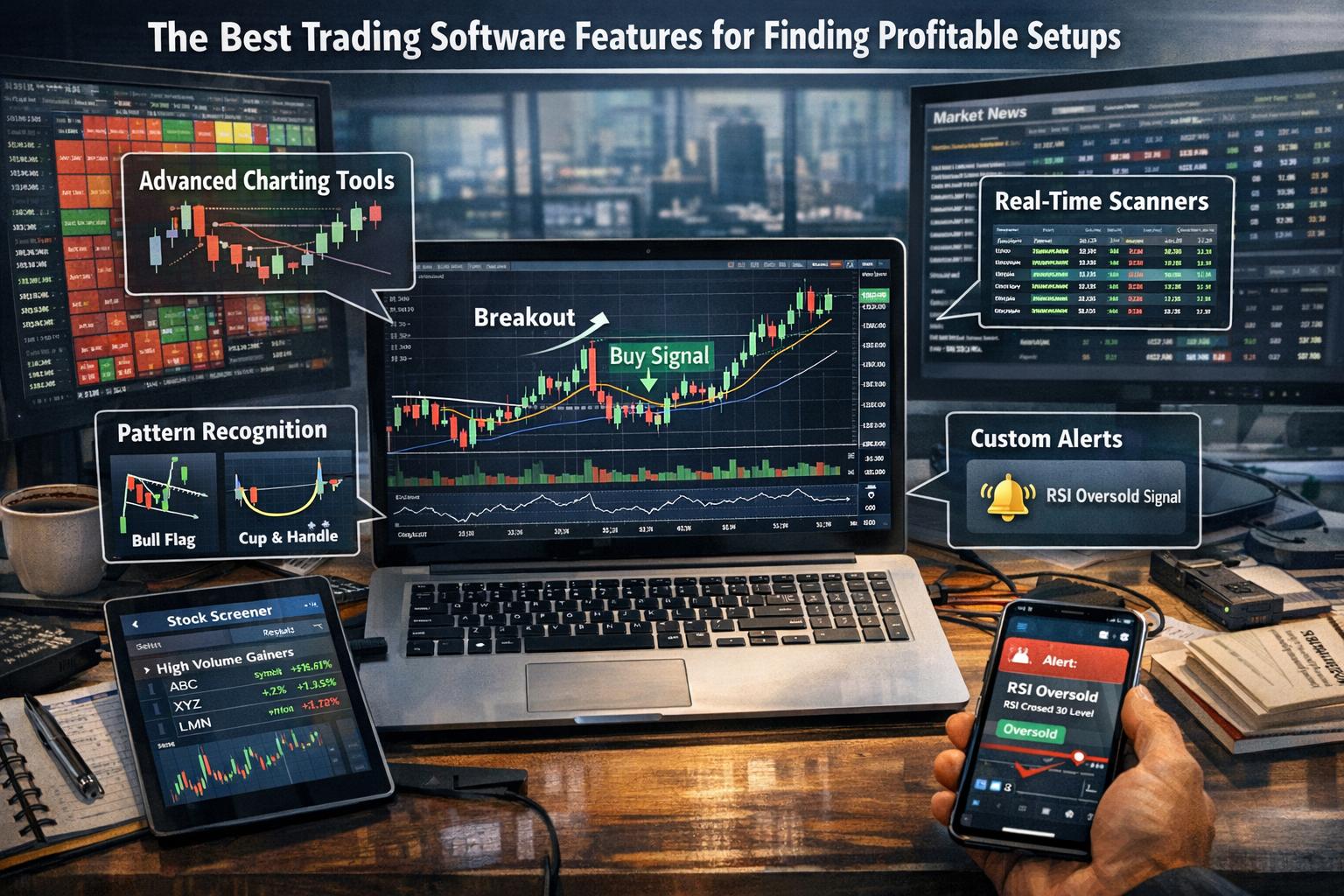
Modern financial markets generate large volumes of data across equities, futures, foreign exchange, cryptocurrencies, and derivatives. Every trading session produces streams of bid and ask updates, executed trades, economic releases, corporate actions, and shifting volatility conditions. Traders increasingly rely on specialized software to process this information, organize it into structured views, and identify potentially profitable setups. The effectiveness of a trading platform depends not only on execution speed but also on the analytical, organizational, and risk management tools it provides. Understanding which features materially contribute to performance allows traders to evaluate platforms with greater precision and align their software choices with specific methodologies.
While market access has become more accessible, extracting consistent value from market movements remains dependent on process. Trading software functions as the operational infrastructure of that process. It shapes how data is interpreted, how opportunities are filtered, how orders are routed, and how outcomes are measured. The difference between a basic interface and a fully integrated analytical environment can materially affect both decision quality and risk exposure.
Comprehensive Market Data Integration
Reliable decision-making begins with accurate and comprehensive data. High-quality trading software integrates real-time price feeds, historical price series, and extended market information across multiple asset classes. Consolidated data feeds reduce discrepancies between sources and ensure that analysis reflects actual tradable conditions. For active traders, even minor latency in price updates can affect entries and exits, particularly in volatile instruments.
Depth of market (DOM) displays, time and sales feeds, and Level II quotes help traders assess liquidity and order flow dynamics. Rather than viewing only the last traded price, traders can observe pending buy and sell interest at various price levels. This additional transparency supports execution planning, particularly for strategies sensitive to slippage or order book imbalance.
For longer-term analysis, platforms should allow access to extended historical records with consistent formatting and minimal data gaps. Clean historical datasets are essential for accurate backtesting and statistical validation. Corporate action adjustments for equities, including dividends and stock splits, must be reflected correctly to prevent distorted performance results. In futures markets, continuous contract construction methods should be transparent, enabling traders to understand how rollover adjustments are handled.
Professional-grade platforms frequently provide adjustable data aggregation. Traders may move between tick-level detail, one-minute intervals, or higher timeframe bars depending on analytical needs. This flexibility allows strategies to adapt across short-term scalping, intraday trading, and multi-day swing positioning. Multi-asset compatibility further strengthens analytical continuity. When equities, index futures, currencies, options, and digital assets can be viewed within a unified interface, cross-market relationships become easier to monitor and interpret.
Advanced Charting Capabilities
Charting tools serve as the visual foundation of most technical trading strategies. Effective trading software offers multi-timeframe chart analysis, customizable layouts, and visualization controls that support comparative assessment. Traders should be able to display several synchronized charts simultaneously, examine higher timeframe structure alongside intraday detail, and align correlated instruments within a common workspace.
Customization extends beyond aesthetics. Adjustable candlestick types, including Heikin Ashi, Renko, range bars, and volume-based bars, allow traders to filter noise and emphasize specific structural characteristics. For example, range bars normalize price movement rather than time intervals, making volatility-based strategies easier to observe. Volume-style bars emphasize participation intensity, which may support confirmation of breakout conditions.
Drawing tools are equally significant. Trendlines, Fibonacci retracements, anchored VWAP tools, regression channels, and custom annotation layers support structured planning. The ability to save and reapply drawing templates improves efficiency, particularly for traders who routinely evaluate similar market environments. Automated synchronization of annotations across timeframes strengthens continuity in analysis.
The integration of automated chart pattern recognition can supplement discretionary review. Algorithms that scan for consolidations, flags, wedges, or reversal patterns can reduce screening time, particularly when applied across broad watchlists. While automated detection should not replace individual interpretation, it may enhance consistency in identifying structural setups aligned with predefined criteria.
Comprehensive Technical Indicator Libraries
Technical indicators remain central to a wide range of systematic and discretionary strategies. A robust trading platform includes standard tools such as moving averages, relative strength index (RSI), MACD, Bollinger Bands, average true range (ATR), and stochastic oscillators. These indicators provide quantifiable measurements of momentum, volatility, mean reversion, and trend persistence.
More advanced participants often require specialized studies, including volume profile analysis, market internals, cumulative delta, and VWAP variations. Order flow metrics and session-based indicators may refine intra-session decision-making. Access to an extensive indicator library reduces the need for external third-party software and maintains analytical consistency within a single ecosystem.
Indicator customization is a distinguishing feature of professional platforms. The capacity to modify default parameters, apply indicators across multiple timeframes, and overlay studies directly on price enhances adaptability. Some platforms enable indicator stacking and conditional formatting, allowing visual emphasis when multiple criteria align.
Support for scripting languages or API-based extensions further strengthens functionality. Traders can design proprietary formulas, construct signal alerts, or systematize specific entry logic through code. Custom scripting also facilitates optimization testing, enabling systematic variation of indicator parameters to evaluate their robustness under changing conditions. Dynamic recalculation in real time ensures that signals update as new price data enters the system, supporting timely decisions.
Backtesting and Strategy Testing Engines
Identifying profitable setups requires structured validation. Integrated backtesting engines allow traders to evaluate how defined strategies would have performed historically. Effective backtesting tools simulate order placement logic, including market and limit entries, stop-loss placements, and conditional exits. Accurate incorporation of commission schedules and slippage modeling increases realism.
Beyond aggregate returns, detailed statistical output is essential. Metrics such as maximum drawdown, recovery factor, Sharpe and Sortino ratios, average trade expectancy, profit factor, and trade duration distribution contribute to comprehensive evaluation. Examining the equity curve’s stability over different market regimes provides insight into whether performance was dependent on favorable trends or resilient under varying volatility conditions.
Walk-forward optimization tools further enhance testing rigor. By dividing historical datasets into in-sample and out-of-sample segments, traders can evaluate whether optimized parameter sets maintain validity beyond the testing period. Monte Carlo simulations may also be available to assess how random trade sequencing could affect capital trajectories.
Paper trading or simulated forward testing bridges the gap between historical evaluation and live deployment. Realistic simulation environments replicate spread changes, partial fills, and order queue priority, improving transition reliability. Traders can evaluate strategy behavior under current conditions without immediate capital exposure.
Market Scanners and Screeners
Opportunity identification across large universes of instruments depends on efficient scanning functionality. Built-in market scanners enable traders to filter assets according to price behavior, volatility expansion, technical crossovers, or relative performance metrics. Parameter-driven filters allow strategies to be translated directly into objective screening criteria.
Real-time updating is particularly important for intraday traders. Instruments that newly meet defined thresholds should automatically appear within dynamic watchlists. For example, a screening rule might identify equities breaking above prior-day highs with above-average volume and positive relative strength. Incorporating time-based filters or sector classifications refines contextual relevance.
For options traders, screeners may include implied volatility rankings, unusual option volume detection, and open interest shifts. Futures traders may scan contracts based on percentage change relative to margin requirements or volatility-adjusted range expansion. Cryptocurrency participants might filter by funding rate extremes or order book imbalance. The broader the filtering framework, the more precisely a trader can align instruments with strategic objectives.
Automated alert systems complement scanning results. Notifications delivered through platform pop-ups or integrated messaging modules enable responsive execution without constant manual monitoring.
Order Execution and Automation Features
Execution quality directly affects realized performance. Trading software should support diverse order types, including market, limit, stop-loss, trailing stop, stop-limit, and conditional triggers. Bracket orders, which attach predefined risk and profit targets to primary entries, promote consistency in trade management.
Advanced routing options can further refine execution outcomes. Direct market access (DMA) may allow traders to select routing venues with potentially improved liquidity or fee structures. Algorithmic routing logic can optimize order placement by splitting larger trades into smaller components to reduce market impact.
Automation capabilities expand strategic flexibility. Platforms supporting algorithmic trading through coded scripts enable systematic rule enforcement without continuous manual intervention. Automation reduces inconsistencies arising from delayed reaction times or incomplete adherence to predefined criteria. In high-frequency environments, low-latency infrastructure and stable connectivity become critical to prevent slippage caused by delayed execution acknowledgment.
Integration with multiple broker APIs consolidates monitoring and order placement workflows. Unified dashboards allow traders to manage positions across accounts without duplicating analysis efforts.
Risk Management and Position Sizing Tools
Sustainable trading performance depends on disciplined exposure control. Platforms that incorporate position sizing calculators allow traders to define risk parameters relative to account equity. By specifying a fixed percentage risk per trade and stop-loss distance, the software can automatically calculate appropriate position size, reducing computational errors.
Margin monitoring features provide visibility into available buying power and maintenance requirements. Portfolio exposure dashboards may display sector concentration, currency exposure, or correlation weighting. When exposure exceeds predefined thresholds, alert systems can prompt reassessment.
Portfolio-level analytics extend beyond single-trade management. Heat maps, value-at-risk projections, and stress testing simulations estimate potential capital fluctuation under adverse scenarios. By modeling sensitivity to broad market declines or volatility spikes, traders can align position sizing with acceptable drawdown tolerance.
Integrated News and Fundamental Data
Technical signals frequently coincide with fundamental catalysts. Trading software that incorporates economic calendars, earnings schedules, and real-time news feeds strengthens contextual awareness. Traders can quickly verify whether unusual price movement corresponds with corporate announcements, macroeconomic releases, or geopolitical developments.
Fundamental screening data provides an additional analytical layer. Ratios such as earnings growth, revenue trends, return on equity, or dividend yield help longer-term traders align technical structures with company performance metrics. For macro-oriented participants, global economic indicators, central bank policy tracking, and commodity inventory reports inform broader directional assessments.
Calendar synchronization features enable proactive planning. Notifications issued ahead of interest rate decisions or employment reports allow traders to adjust exposure before anticipated volatility periods.
Customization and User Interface Efficiency
Interface structure directly influences productivity. Customizable layouts, detachable chart windows, and multi-monitor support permit efficient organization of analytical tools. Traders employing complex strategies may require simultaneous access to price action, order flow visualization, scanning outputs, and position management panels.
Hotkeys for rapid order entry, pre-configured templates for bracket orders, and workspace-saving functionality streamline repetitive processes. The ability to preserve workspace configurations across sessions ensures operational continuity. Cloud-based synchronization increasingly maintains templates and watchlists across desktop and mobile devices.
An interface that minimizes unnecessary clicks and redundant navigation supports sustained concentration during active market hours. Visual clarity, stable performance, and logically grouped toolsets reduce operational friction.
Performance Analytics and Journaling
Ongoing evaluation remains central to systematic improvement. Integrated trade journaling features record entry conditions, exit rationale, screenshots, and realized results. By categorizing trades by setup type, timeframe, or instrument, traders can quantify which approaches generate consistent statistical advantage.
Advanced performance dashboards provide segmented analysis. Results can be filtered by time of day, market regime, volatility percentile, or strategy tag. Distribution charts of trade returns reveal the balance between average gain and loss magnitude. Drawdown tracking highlights capital contraction phases and recovery durations.
Exportable reports in standardized formats facilitate external analysis or record-keeping. For professional environments, the capacity to document decision processes and maintain verifiable logs supports structured oversight.
Security, Reliability, and Compliance
Operational continuity is fundamental in volatile markets. Stable server infrastructure and redundancy protocols reduce the probability of outage-driven disruption. During high-volume sessions, reliable connectivity ensures that open positions remain controllable.
Security architecture should include end-to-end encryption, multi-factor authentication, and secure session management. API permissions must be configurable to limit access exposure. Evaluation of a broker’s regulatory framework further informs capital protection considerations.
Compliance features such as detailed audit trails, timestamped order logs, and transaction export capability assist institutional users in satisfying regulatory obligations. Transparent reporting structure enhances accountability.
Adaptability to Different Trading Styles
Trading methodologies vary significantly in timeframe, asset preference, and analytical emphasis. Intraday participants prioritize rapid data refresh rates and real-time scanners. Swing traders may emphasize multi-session chart alignment and earnings overlays. Long-term investors often focus on portfolio diversification analytics and macroeconomic dashboards.
Effective software architecture accommodates diverse approaches without excessive complexity. Modular add-ons, scalable subscription tiers, and upgrade pathways permit gradual capability expansion. Transitioning from manual discretionary trading to semi-automated or fully algorithmic models should not require migration to an entirely new ecosystem.
Data Visualization and Order Flow Analysis
As algorithmic participation has expanded, order flow visualization tools have gained relevance. Features such as footprint charts, cumulative delta tracking, and volume-at-price histograms expose underlying participation patterns. Traders analyzing liquidity absorption or initiative buying may rely on these granular insights to refine entries within broader technical frameworks.
Heat maps illustrating resting liquidity across price levels assist in identifying potential support or resistance clusters. When combined with higher timeframe structural analysis, these tools can clarify entry timing and risk placement decisions. Although such visualization layers are not required for all participants, they extend analytical depth for strategies focused on precision execution.
Conclusion
The most effective trading software integrates comprehensive market data, advanced charting, customizable indicators, rigorous testing engines, structured risk controls, and stable execution infrastructure within a secure environment. Profitable setups typically emerge from the interaction of technical structure, contextual fundamentals, and disciplined capital management rather than from isolated signals.
Scanning tools reduce opportunity search time, backtesting engines validate assumptions, automation supports rule consistency, and performance analytics inform iterative refinement. Risk management features preserve capital stability, while customizable interfaces enhance operational efficiency. Collectively, these capabilities transform trading software from a passive display instrument into an analytical decision-support system.
Evaluating a trading platform therefore requires attention to analytical depth, execution reliability, adaptability across asset classes, and long-term scalability. Platforms that unify structured data access with disciplined risk and performance frameworks provide traders with the infrastructure necessary to methodically identify, execute, and manage opportunities across evolving market conditions.