
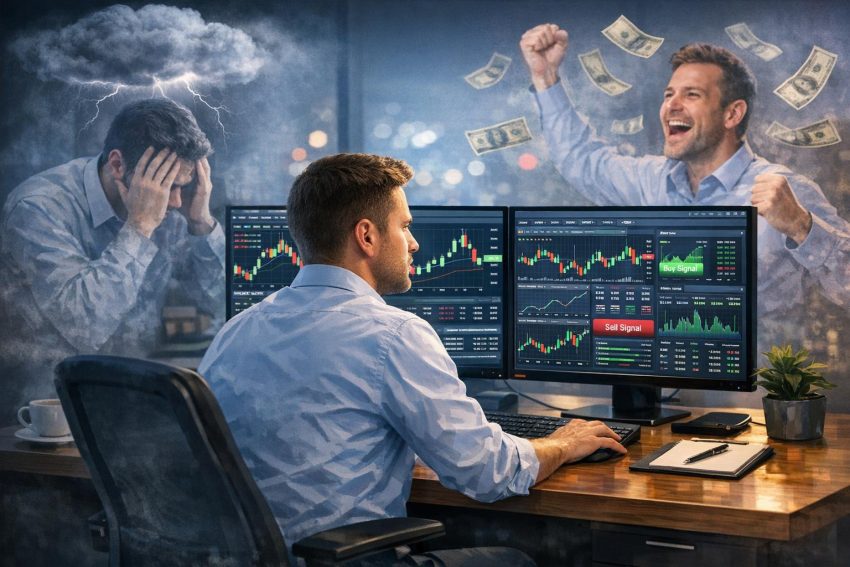
Emotional decision-making has long been recognized as one of the primary obstacles to consistent trading performance. Financial markets are influenced by uncertainty, rapid price movements, and continuous information flow, all of which generate psychological pressure. Trading software has emerged as a technological framework designed not only to improve operational efficiency but also to reduce the influence of human emotion on buying and selling decisions. By automating processes, standardizing analysis, and enforcing predefined rules, modern trading systems create structure in environments that often provoke impulsive behavior.
The Psychological Foundations of Trading Behavior
Financial markets are environments of probabilistic outcomes rather than certainty. Every trade involves incomplete information and exposure to loss. From a psychological perspective, uncertainty activates neural mechanisms associated with threat detection and reward anticipation. This biological response predisposes individuals to react emotionally, even when they intend to behave rationally.
In trading contexts, fear frequently manifests when markets move against a position. A decline in price may trigger an instinctive desire to exit immediately, regardless of whether objective criteria justify that decision. Greed, by contrast, may encourage traders to increase risk exposure beyond their predefined limits after experiencing profitable trades. These reactions are not isolated incidents but recurring behavioral patterns documented extensively in behavioral finance research.
Other common influences include loss aversion, where losses are perceived as more significant than equivalent gains; confirmation bias, in which traders selectively interpret information that supports their existing positions; and recency bias, where recent events disproportionately influence expectations about future outcomes. While training and experience can mitigate these tendencies, they cannot eliminate them entirely because they stem from fundamental cognitive processes.
Trading software addresses these behavioral patterns indirectly. Rather than attempting to change emotional responses, it restructures decision-making environments so that emotional impulses have fewer opportunities to distort action.
The Emotional Challenges in Volatile Markets
Volatility intensifies psychological strain. Rapid price fluctuations compress decision timelines, leaving little opportunity for deliberate analysis. During high-volatility periods, traders may feel compelled to act immediately in order to avoid perceived missed opportunities or prevent further losses.
In such conditions, discretionary trading becomes particularly vulnerable to emotional bias. A trader may enter a position prematurely after observing a sudden upward price movement, motivated by fear of missing out. Alternatively, abrupt declines may prompt liquidation unrelated to the broader strategic framework.
Continuous exposure to market screens compounds this effect. Watching tick-by-tick price changes encourages short-term thinking. Minor price movements, which might be statistically insignificant within a broader trend, can appear more consequential when viewed in isolation. Trading software reduces the need for constant manual monitoring by executing rules systematically, thereby minimizing exposure to emotionally charged stimuli.
Rule-Based Execution and Structured Automation
One of the primary mechanisms through which trading software limits emotional decision-making is rule-based execution. Rules are defined before trades are placed and are typically based on quantifiable indicators such as moving averages, volatility bands, momentum oscillators, or statistical thresholds. Once parameters are established, the system executes trades automatically when conditions are met.
This structure separates strategic thinking from tactical action. Strategy development occurs under relatively calm circumstances, often supported by thorough analysis and historical testing. Execution, however, takes place automatically, without requiring real-time judgment influenced by stress or excitement.
Automation does not remove human involvement; instead, it repositions it. The trader’s role shifts from reactive decision-making to proactive system design and evaluation. As a result, impulsive deviations are less likely to interfere with strategy integrity.
In addition, algorithmic systems maintain consistency across market environments. Whether markets are trending, consolidating, or experiencing turbulence, predefined rules apply uniformly. This consistency contrasts with discretionary approaches, where identical signals may be handled differently depending on emotional state.
Predefined Risk Management and Capital Preservation
Risk management is central to long-term trading sustainability. Emotional responses frequently interfere with prudent risk control. After experiencing losses, traders may widen stop-loss levels to avoid realizing those losses, transforming manageable risks into significant drawdowns. Conversely, a sequence of successful trades may lead to disproportionate increases in position size.
Trading software incorporates predefined risk controls that operate automatically. Stop-loss orders, take-profit targets, and trailing stops are executed without hesitation. These mechanisms ensure that maximum loss limits are respected, regardless of changing sentiment.
Advanced systems also integrate volatility-adjusted position sizing. By linking trade size to metrics such as average true range or portfolio value, software maintains proportional exposure relative to market conditions. During volatile periods, position sizes may automatically decrease, preserving capital stability.
Portfolio-level risk management further strengthens discipline. Software can enforce limits on total exposure, sector concentration, or correlation among assets. Such controls prevent overcommitment driven by enthusiasm for specific themes or narratives.
Backtesting and Quantitative Validation
Historical backtesting allows traders to evaluate how a strategy would have performed under past market conditions. By analyzing data across various timeframes, economic cycles, and volatility regimes, backtesting produces a statistical profile of performance characteristics.
Metrics such as win rate, maximum drawdown, profit factor, and Sharpe ratio provide objective benchmarks. These measurements help traders assess whether fluctuations in live performance fall within historical norms. When temporary losses occur, reference to backtested data can reduce the likelihood of emotionally abandoning a fundamentally sound strategy.
Backtesting also encourages systematic refinement. Instead of modifying strategies reactively after each unfavorable outcome, traders can apply quantitative adjustments based on structured analysis. This disciplined process contrasts with emotionally driven changes that lack empirical justification.
However, effective use of backtesting requires attention to methodological integrity. Excessive optimization may produce results that reflect curve-fitting rather than genuine predictive capacity. Responsible system design therefore balances empirical testing with realistic assumptions.
Real-Time Monitoring Without Constant Intervention
Manual monitoring of multiple markets can create cognitive overload. Simultaneous evaluation of price patterns, macroeconomic releases, and geopolitical developments increases psychological strain. When information becomes overwhelming, decision quality may decline.
Trading platforms address this challenge through automated scanning and alert functions. Traders define conditions of interest, and the system monitors markets continuously. When criteria are satisfied, notifications are issued. This process narrows attention to relevant signals and reduces continuous exposure to fluctuating prices.
Performance dashboards contribute to structured oversight. Visual summaries of equity curves, open positions, margin usage, and historical returns present complex data in organized formats. By contextualizing short-term movements within broader performance trends, dashboards help maintain analytical perspective.
Consistency and Statistical Integrity
Any trading strategy relies on repeated application of an identifiable edge. Emotional inconsistency disrupts this process. Skipping trades after losses or doubling exposure after gains alters the statistical distribution of outcomes, making performance evaluation unreliable.
Trading software enforces uniform execution across all qualifying signals. Each trade that meets predefined criteria is treated identically. Over extended periods, this consistency allows traders to evaluate strategy effectiveness with greater confidence.
Consistency also enhances transparency. Automated trade logs record precise entry and exit points, timestamps, and execution prices. Such documentation reduces reliance on memory, which may be distorted by hindsight bias. Clear records promote objective review and continuous improvement.
Reduction of Cognitive Bias Through Structured Interfaces
Software interfaces present data systematically through charts, numerical summaries, and algorithmic indicators. Structured presentation reduces interpretive ambiguity. Instead of relying solely on subjective chart reading, traders can incorporate quantitative thresholds that define actionable signals.
This structured environment discourages impulsive reinterpretation of market conditions. When indicators either meet or fail to meet specific criteria, decisions follow predefined logic rather than fluctuating personal opinions. The framework does not eliminate judgment entirely, but it channels judgment into rule development rather than moment-to-moment reaction.
Separation Between Strategic Planning and Market Noise
Modern markets operate continuously, accompanied by extensive commentary from analysts, news outlets, and social media participants. Constant exposure to narratives may amplify emotional reactions, particularly when commentary conflicts with existing positions.
Systematic trading environments provide insulation from such noise. Strategies are constructed using defined parameters that incorporate relevant data inputs. Once implemented, execution depends on measurable conditions rather than interpretive narratives.
This separation does not imply that fundamental analysis is excluded. Instead, relevant economic variables can be integrated systematically into models. By quantifying their influence, the system reduces discretionary reinterpretation triggered by headlines.
Performance Tracking and Behavioral Feedback
Comprehensive performance analytics play a central role in emotional regulation. Many platforms include journals that record not only transaction data but also contextual notes. Reviewing this information enables traders to identify recurring behavioral deviations.
For discretionary elements, metrics can reveal tendencies such as premature exits or delayed stop adjustments. Quantitative evidence of these patterns encourages corrective measures. Behavioral insight becomes data-driven rather than introspective alone.
Longitudinal performance tracking also fosters realistic expectations. Markets fluctuate, and even robust strategies experience drawdowns. Reviewing historical distributions of returns helps contextualize temporary underperformance, reducing reactive decision-making.
Institutional Adoption and Operational Discipline
Institutional investors rely extensively on algorithmic systems to ensure standardized execution. Large portfolios require consistent application of strategy across numerous instruments and accounts. Human discretion at scale would introduce variability and operational risk.
Automated execution platforms manage order routing, liquidity optimization, and transaction cost control. These processes occur according to objective parameters, preserving strategic alignment across teams. Institutional reliance on technology underscores its value in mitigating behavioral inconsistencies.
High-frequency trading environments provide an extreme illustration. Decisions occur within milliseconds, far exceeding human reaction capabilities. Emotional influence is functionally eliminated at the execution level; system performance depends entirely on algorithmic precision and technical infrastructure.
Integration of Artificial Intelligence and Adaptive Models
Advancements in artificial intelligence extend the capacity of trading software to analyze complex, high-dimensional data sets. Machine learning models detect nonlinear relationships that may not be visible through traditional analysis. These systems evaluate probabilities mathematically, free from cognitive bias.
Adaptive algorithms can recalibrate parameters based on evolving market behavior. For example, volatility clustering or regime shifts may prompt systematic adjustments within predefined safeguards. Such adaptability reduces reliance on reactive human intervention.
Nevertheless, oversight remains necessary. Model governance, validation, and risk supervision require disciplined management. Emotional decisions may still influence higher-level choices, such as model replacement or capital allocation adjustments. Technology therefore complements, rather than replaces, governance structures.
Limitations and Responsible Use of Automation
While trading software significantly reduces emotional interference, it cannot entirely eliminate it. Human judgment determines strategy design, risk tolerance, and system activation. Emotional impulses may influence these meta-level decisions.
Abandoning a system during temporary drawdowns, increasing leverage after favorable performance, or over-optimizing parameters based on recent data are examples of residual behavioral risk. Effective technology use therefore depends on disciplined oversight and adherence to long-term evaluation frameworks.
Furthermore, automated systems are exposed to technical risks, including connectivity disruptions and execution errors. Comprehensive safeguards, including redundancy protocols and monitoring mechanisms, are essential to ensure operational reliability.
Conclusion
Emotional decision-making presents persistent challenges in financial trading due to inherent uncertainty and risk exposure. Psychological biases such as fear, greed, and loss aversion can disrupt consistent strategy execution. Trading software addresses these vulnerabilities by enforcing rule-based automation, maintaining predefined risk controls, supporting quantitative validation, and providing structured performance monitoring.
By separating planning from execution, reducing cognitive overload, and standardizing analytical processes, technology reshapes the trading environment into one governed primarily by objective criteria. Human oversight remains integral, particularly in system design and governance. However, the operational discipline embedded in modern trading platforms substantially limits opportunities for impulsive action.
In increasingly complex and data-intensive markets, systematic trading software offers a framework that aligns decision-making with predefined logic rather than fluctuating sentiment. Although no technological solution can guarantee favorable outcomes, structured automation promotes consistency, transparency, and disciplined risk management—core attributes for sustainable market participation.