
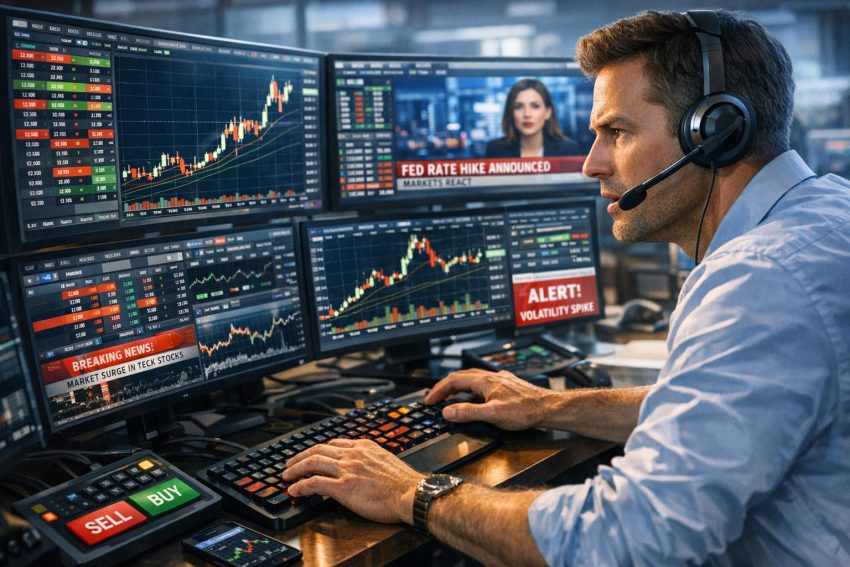
The Role of Trading Software in Modern Day Trading
Day trading operates within compressed time horizons where price fluctuations can develop and reverse within minutes or seconds. Market participants respond continuously to macroeconomic releases, corporate disclosures, institutional flows, and evolving expectations about interest rates, liquidity, and risk. In such conditions, the ability to gather information, interpret it, and execute decisions without delay becomes structurally important. Trading software is the primary system through which this process occurs.
Rather than serving as a simple order entry tool, modern trading platforms function as integrated environments. They connect traders to exchanges, aggregate data from multiple liquidity venues, calculate technical metrics, display evolving price structures, and manage open risk exposures. In day trading, where margins for error are narrow and timing affects profitability, software infrastructure influences outcomes directly.
Contemporary markets are largely electronic. Floor-based trading has been replaced by automated matching engines operating in data centers. As a result, traders interact with markets through digital interfaces. The quality of that interface—its speed, reliability, flexibility, and analytical depth—defines how efficiently a trader can operate during fast market cycles.
Real-Time Market Data and Low Latency Feeds
Real-time market data forms the foundation of day trading activity. Quotes update continuously as participants modify bids and offers, submit new orders, or cancel existing ones. Trading software processes these updates tick by tick and reflects them visually within charts, order books, and time-and-sales windows.
Access to consolidated and direct exchange feeds ensures that traders observe actual market conditions rather than delayed snapshots. Level I data typically displays the best bid and ask, while Level II and depth-of-market views expose multiple layers of resting liquidity. For short-term traders analyzing supply and demand imbalances, this granularity is essential.
Latency measures the delay between an exchange event and its display on a trader’s interface. Even marginal delays can affect execution quality during rapid price transitions. Modern platforms reduce latency through optimized routing, colocated servers, and high-speed connections to exchange gateways. In competitive strategies such as momentum breakouts or news-based trading, lower latency shortens the reaction window between signal emergence and trade placement.
Software also manages data normalization. Prices from various exchanges may arrive in slightly different formats or time sequences. The platform harmonizes this information, ensuring coherent chart formation and accurate calculations. Efficient processing reduces computational overhead and maintains platform responsiveness under high data loads.
Advanced Charting and Technical Analysis Infrastructure
Charting engines embedded within trading software transform raw price inputs into structured visual models. Candlestick, bar, line, and area charts represent price movement across multiple timeframes, from one-second intervals to daily aggregates. For day traders, shorter intervals dominate because they reflect intraday volatility.
Technical indicators are calculated dynamically as new data is received. Common tools such as moving averages, relative strength index (RSI), moving average convergence divergence (MACD), stochastic oscillators, and volume-weighted average price (VWAP) update automatically without manual recalculation. By embedding formula engines inside the software, analytical processes remain synchronized with live price movement.
Customization expands this capability. Traders adjust parameters, overlay multiple studies, or build composite indicators reflecting proprietary logic. Chart templates allow standardized configurations across instruments, limiting repetitive setup steps. In high-speed environments, reducing preparation time directly supports faster interpretation.
Multi-monitor compatibility further enhances visual analysis. Traders frequently dedicate separate screens to different asset classes, timeframes, or order flow views. Software designed to distribute and synchronize data across displays reduces friction in information transfer and preserves continuity across trading sessions.
Direct Market Access and Order Routing Architecture
Direct market access (DMA) connects traders electronically to exchanges and alternative trading systems without manual brokerage intervention. Orders are transmitted through structured routing networks that prioritize speed and execution efficiency. For day traders, minimizing the interval between order submission and confirmation is a priority.
Advanced order routing logic selects among liquidity venues based on price availability, execution probability, and fees. Some platforms permit manual venue selection, giving traders the option to target specific exchanges or electronic communication networks (ECNs). This flexibility can influence slippage and execution consistency.
Hotkeys and single-click order panels are integral to rapid trade placement. By predefining share size, risk limits, and routing preferences, traders execute strategies without entering details repeatedly. Confirmation windows can be adjusted or minimized to reduce interruption during high-volatility periods.
Order types extend beyond simple market and limit instructions. Day trading software frequently supports stop-limit orders, market-if-touched orders, iceberg orders, and conditional brackets. These structures enable more precise engagement with liquidity, especially during price accelerations or retracements.
Automation and Algorithmic Functionality
Automation introduces rule-based decision execution into day trading workflows. Instead of reacting manually to each price event, traders can define conditional logic that triggers actions immediately when predefined parameters are satisfied. This reduces dependency on constant monitoring and shortens response intervals.
Basic automation includes automatic stop-loss and take-profit placement attached to every new position. More advanced capabilities incorporate scripted strategies that scan for technical patterns, volatility expansions, or statistical deviations. When conditions align, the algorithm initiates the trade without discretionary input.
Many platforms include proprietary scripting languages or compatibility with established programming environments. Through these tools, traders build, test, and deploy custom models. Execution speed becomes machine-dependent rather than human-dependent, often measured in milliseconds.
Algorithmic control also improves consistency. Emotions and hesitation can alter manual decision timing. Automated systems apply uniform logic as coded, which can stabilize trade execution behavior within a structured framework.
Integrated Risk Controls and Exposure Monitoring
Risk management in day trading operates on compressed timescales. Losses can accumulate rapidly when volatility rises. Trading software therefore embeds protective mechanisms designed to respond automatically.
Stop-loss orders close positions once predetermined thresholds are reached. Trailing stops adjust incrementally as favorable price movement occurs. Bracket orders combine entry, profit target, and stop-loss logic within a single structured command. These features act without requiring manual confirmation at the moment of trigger.
Real-time profit and loss dashboards provide continuous updates of realized and unrealized performance. Margin utilization, buying power, and exposure by instrument or asset class are recalculated instantly as positions change. Visual risk indicators, such as color transitions or threshold alerts, assist in maintaining discipline.
Some platforms impose daily loss limits or maximum position sizes configurable by the trader or brokerage. When thresholds are reached, the system can restrict additional order placement. These controls help contain cumulative exposure during periods of heightened volatility.
Market Scanning and Integrated News Feeds
Monitoring thousands of tradable instruments manually is not practical. Trading software addresses this through built-in scanners that evaluate entire exchanges in real time. Parameters may include percentage change, intraday range expansion, unusual volume, volatility contraction, or price relative to VWAP.
Scanners update continuously, presenting filtered results sorted by relevance or magnitude. This mechanism transforms raw market breadth into actionable subsets aligned with specific strategies. By automating opportunity detection, traders devote more attention to evaluation and risk control.
Integrated news feeds supplement quantitative scanning. Earnings releases, analyst revisions, regulatory announcements, and macroeconomic updates can alter market dynamics quickly. Platforms that display headlines and time stamps within the same interface eliminate the need to switch between applications. Time alignment between price reaction and information release enhances contextual analysis.
User Interface Design and Information Processing
The structure of a platform’s interface influences cognitive efficiency. Trading software developers emphasize clarity, modular layout systems, and customizable panels. Traders tailor workspaces to highlight the information corresponding to their methodology.
Color differentiation, font sizing, and spatial organization contribute to rapid comprehension. Depth-of-market ladders may highlight aggressive buying or selling pressure. Heat maps visualize liquidity concentrations across price levels. These graphical approaches compress complex numerical data into intuitive formats suitable for immediate interpretation.
Performance stability under stress is equally important. During high-volume market events, the interface must remain responsive. Efficient memory management and optimized graphical rendering prevent lag that could interfere with decision timing.
Backtesting, Simulation, and Strategy Calibration
Although execution occurs in real time, preparation often relies on historical evaluation. Many trading platforms provide backtesting environments where strategies are applied to archived price data. By analyzing past scenarios, traders estimate probable performance metrics, including win rate, drawdown magnitude, and profit distribution.
Simulation modules replicate live market conditions without financial risk. Orders entered in simulated mode receive hypothetical fills based on recorded liquidity parameters. This environment allows refinement of hotkey usage, algorithm behavior, and risk settings.
Optimization engines iterate through parameter combinations to identify configurations that align with defined performance criteria. While historical results do not guarantee future outcomes, systematic evaluation reduces uncertainty when transitioning to live deployment.
Cross-Platform Synchronization and Mobile Capability
Contemporary trading infrastructure increasingly operates across desktop, browser-based, and mobile interfaces. Cloud synchronization ensures that open positions, watchlists, chart annotations, and alert configurations remain identical across devices.
Mobile applications provide monitoring flexibility when traders are away from primary workstations. Push notifications transmit price alerts or news events instantly. Order entry through secure mobile gateways enables position adjustment under unexpected conditions. Although mobile platforms may not match desktop systems in analytical depth, they extend operational continuity.
Security frameworks, including multi-factor authentication and encrypted data transmission, protect account integrity across these synchronized environments. Reliability and cybersecurity directly influence confidence in remote access functionality.
API Connectivity and External System Integration
Through application programming interfaces (APIs), trading software can exchange data with external analytical engines, portfolio management systems, or proprietary dashboards. APIs provide structured communication protocols that allow custom applications to retrieve market data, submit orders, and monitor account metrics programmatically.
This interoperability supports quantitative research workflows. Data scientists may employ statistical packages to model correlations or volatility estimates, then transmit trade instructions back to the brokerage platform automatically. Removing manual data transfer reduces delay and potential transcription errors.
Institutional traders often integrate compliance monitoring and reporting tools within the same architecture. Automated records of order timestamps, modifications, and executions provide audit transparency while preserving operational speed.
Server-Side Infrastructure and Reliability Engineering
Server-side order management relocates certain instructions to broker-controlled infrastructure. For example, stop-loss triggers stored on remote servers remain active even if the local device disconnects. This redundancy reduces the risk associated with hardware malfunction or internet instability.
Cloud computing environments distribute computational load across multiple geographic regions. Load balancing systems detect traffic surges and allocate resources accordingly. During periods of exceptional volatility, such as major economic announcements, scalable architecture helps maintain performance continuity.
Regular system updates, patch management, and real-time diagnostics detect irregularities before they escalate. Resilience against outages is a structural requirement in electronic trading ecosystems where downtime can translate into measurable financial exposure.
Limitations, Operational Risks, and Regulatory Context
Despite advanced functionality, trading software remains subject to constraints. Technical defects, delayed data packets, or routing failures can disrupt execution sequences. Traders must understand contingency procedures, including alternative order placement methods or broker support channels.
Overreliance on automation without adequate supervision introduces model risk. Algorithms built on historical relationships may underperform if market structure evolves. Continuous review and recalibration are part of responsible deployment.
Regulatory frameworks govern leverage, order-to-trade ratios, and algorithmic disclosure requirements in many jurisdictions. Platforms often incorporate compliance safeguards, but accountability ultimately remains with the trader or institution. Awareness of exchange rules and brokerage policies ensures that technological capabilities are applied within permissible boundaries.
Conclusion
Trading software functions as the operational core of modern day trading. It consolidates live market data, analytical modeling, order routing, automation, and risk management within a unified digital structure. Through low-latency feeds and optimized execution pathways, it reduces the interval between market development and decisive action.
Advanced visualization tools support rapid interpretation of volatility and liquidity shifts. Automation enhances consistency, while integrated controls manage exposure dynamically. Backtesting, scanning, and cross-platform synchronization extend efficiency beyond the trading session itself.
Although technology does not eliminate market risk, it defines how effectively traders engage with fast-moving environments. Proper configuration, disciplined strategy design, and continuous system monitoring allow trading software to serve as a structured, high-speed interface between human judgment and electronic financial markets.