
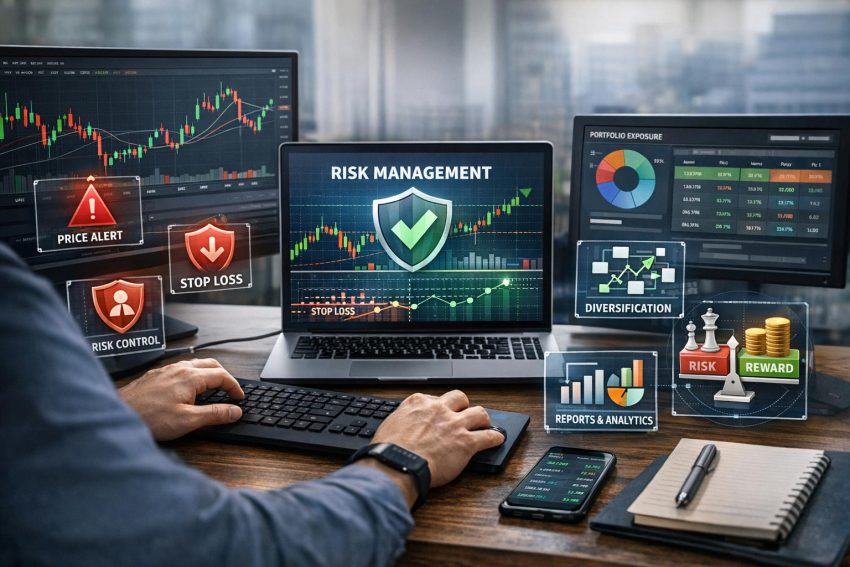
Risk management is central to sustainable trading. While market knowledge and discipline remain essential, modern trading platforms provide tools that significantly improve how traders identify, measure, and control exposure. These platforms integrate analytics, automation, and real-time data into a unified environment, allowing traders to make structured decisions rather than reactive ones. As financial markets become faster, more global, and increasingly interconnected, the role of technology in managing trading risk has expanded accordingly.
In earlier market environments, many risk calculations were performed manually, and monitoring required constant personal oversight. Today, platforms consolidate execution, analytics, reporting, and compliance tools into a single interface. This consolidation reduces operational friction and allows traders to align position management with predefined risk parameters. Rather than focusing solely on identifying profitable opportunities, traders can continuously evaluate how each decision affects total account stability.
Understanding Risk in Financial Markets
Risk in trading refers to the possibility of financial loss due to price fluctuations, market volatility, liquidity constraints, leverage, and unexpected external developments. Financial markets are influenced by macroeconomic announcements, corporate events, political developments, and structural factors such as interest rate shifts or currency fluctuations. Each of these elements introduces variability into pricing behavior.
Traders generally face multiple layers of exposure. Market risk arises from adverse price movements in equities, commodities, currencies, or derivatives. Liquidity risk occurs when positions cannot be exited at expected prices due to insufficient market participation. Counterparty risk refers to the possibility that the other party in a transaction fails to meet its obligation. Operational risk includes technological failures, connectivity disruptions, or procedural errors that affect execution.
Effective control requires a structured framework: identifying the type of risk, measuring its probable magnitude, defining acceptable thresholds, and applying safeguards. Trading platforms formalize this process. Instead of relying on estimation or memory, traders can review continuously updated exposure metrics within the system dashboard. This structured visibility forms the foundation of systematic risk governance.
Real-Time Market Data and Transparency
Access to timely and accurate information directly affects the ability to control losses. Trading platforms deliver real-time price feeds, time-stamped transaction records, historical charts, and order book depth. By presenting price data without significant delay, platforms reduce the informational lag that may otherwise amplify sudden losses.
Order book transparency allows traders to observe bid and ask volumes across price levels. This visibility helps assess short-term liquidity conditions and identify potential slippage risks. If market depth appears thin, position size or entry timing can be adjusted before execution.
Advanced charting functionality supplements raw price data. Technical indicators such as moving averages, volatility bands, relative strength measurements, and momentum oscillators are embedded within the interface. While indicators do not guarantee outcomes, they provide structured frameworks for evaluating prevailing conditions. By aligning trade entries with defined analytical signals rather than impulse decisions, traders reduce inconsistencies in execution.
Integrated news feeds further enhance situational awareness. Platforms aggregate financial headlines, earnings disclosures, and macroeconomic updates in synchronized panels. When volatility rises in response to breaking events, traders can assess context immediately instead of seeking information across multiple sources. This consolidation contributes to more coordinated responses under time-sensitive conditions.
Order Types That Limit Losses
Order functionality represents one of the most direct forms of built-in risk control. Beyond basic market and limit orders, platforms offer protective structures designed to define exit conditions in advance. These tools transform risk planning from an abstract intention into an enforceable mechanism.
Stop-loss orders close positions once a predetermined price is reached. By specifying the maximum acceptable loss at entry, traders establish a numerical boundary that limits downside exposure. This approach removes the need for continuous manual intervention and reduces the temptation to postpone exit decisions during adverse moves.
Take-profit orders function similarly on the upside. They secure gains when predefined targets are achieved, reducing prolonged exposure and preventing profits from reverting due to sudden reversals. Establishing both stop-loss and take-profit levels at the outset transforms the trade into a structured risk-reward equation.
Trailing stop orders dynamically adjust as prices move favorably. When the market advances, the stop level shifts accordingly, preserving accumulated gains while still allowing price fluctuation within defined limits. This adaptive structure is particularly useful in trending markets where rigid targets may prematurely close positions.
Conditional and bracket orders add further sophistication. Traders can link multiple instructions so that execution of one automatically activates or cancels another. Such automation reduces operational errors and ensures that exit parameters remain synchronized with live positions.
Position Sizing and Exposure Calculations
Determining position size is fundamental to risk stability. Even a well-structured trade can jeopardize account balance if too much capital is concentrated in a single position. Modern platforms provide integrated position sizing calculators that convert percentage-based risk tolerance into exact volume metrics.
For instance, if a trader defines a maximum exposure of 1 or 2 percent of account equity per trade, the platform can calculate the corresponding number of shares, contracts, or currency lots based on entry price and stop-loss distance. This eliminates approximation and aligns execution with predefined capital management rules.
Exposure dashboards extend this oversight across the entire portfolio. They aggregate open positions, calculate net directional bias, and identify overlapping exposures. If several trades are linked to correlated assets, cumulative risk may exceed intended limits. The system’s summary view highlights such concentration, enabling corrective action before volatility intensifies.
This quantitative clarity transforms risk control from a subjective judgment into a repeatable process grounded in numerical consistency.
Margin Monitoring and Leverage Control
Leverage magnifies both opportunity and vulnerability. By borrowing capital to enlarge positions, traders increase market exposure beyond their deposited funds. While leverage can improve capital efficiency, it also accelerates drawdowns if markets move unexpectedly.
Trading platforms display real-time margin utilization, free margin levels, and maintenance requirements. Continuous monitoring ensures that traders understand how much capital supports open positions. If equity declines toward maintenance thresholds, the platform issues automated warnings.
Margin alerts function as early intervention signals. Rather than discovering overexposure after forced liquidation, traders receive advance notification that positions require adjustment. Some platforms present visual indicators—such as color-coded bars—that illustrate how close accounts are to margin triggers. These graphical elements simplify interpretation and reinforce disciplined leverage usage.
Leverage ratios are likewise displayed in percentage or multiple format. Clear transparency surrounding borrowed capital encourages structured borrowing practices and reduces reliance on subjective comfort levels.
Portfolio Diversification Tools
Diversification serves as a foundational principle in exposure control. Concentrating capital in a single asset or sector increases vulnerability to localized downturns. Modern platforms incorporate screening utilities and analytics designed to reveal allocation patterns.
Asset filters allow traders to examine opportunities across industries, geographies, and asset classes. Correlation matrices evaluate how instruments historically move relative to one another. If two securities demonstrate strong positive correlation, holding both in large quantities may amplify directional risk rather than reduce it.
Portfolio allocation summaries display the proportion of capital assigned to equities, currencies, commodities, or derivatives. Currency exposure reports further detail foreign exchange sensitivity embedded within international holdings. By providing these consolidated insights, platforms enable traders to rebalance portfolios without exporting data to external spreadsheets.
This integrated perspective reduces fragmentation in oversight and strengthens coherence between strategy and allocation.
Volatility Indicators and Quantitative Risk Metrics
Volatility measurement supports realistic expectations of potential price movement. Platforms integrate indicators such as Average True Range (ATR), standard deviation bands, and implied volatility readings derived from options markets. These metrics estimate how widely prices may fluctuate within specific intervals.
If volatility expands, stop-loss distances and position sizing may require adjustment. Ignoring volatility conditions can result in premature stop activation or excessive leverage during turbulent periods. By embedding volatility analysis directly within the trading interface, platforms encourage adaptive parameter calibration.
Some advanced systems incorporate Value at Risk (VaR) calculations, which estimate the maximum projected loss over a defined timeframe at a specified confidence level. Scenario analysis tools allow traders to simulate hypothetical shocks, such as interest rate changes or currency devaluations. While projections remain probabilistic, they provide structured insight into possible capital erosion.
Historical performance testing further strengthens risk comprehension. Backtesting engines evaluate how strategies would have performed under past market conditions. By reviewing historical drawdowns, traders gain perspective on worst-case scenarios and adjust exposure accordingly.
Automation and Algorithmic Controls
Automation introduces consistency into execution. Many trading platforms support algorithmic strategies that translate predefined rules into executable code. Entry signals, exit thresholds, position limits, and risk ceilings can all be embedded within the algorithm.
This structure minimizes hesitation during rapid market transitions. It also enforces objective compliance with risk policies, such as suspending trading after reaching a daily loss ceiling. By embedding loss-limitation rules directly into execution logic, technology prevents repetitive behavioral errors.
Even for discretionary traders, partial automation proves valuable. Alerts based on price thresholds, volatility spikes, or indicator crossovers allow proactive monitoring without constant screen observation. Scheduled activation of strategies within defined hours further reduces exposure to unmonitored overnight developments.
Automation does not eliminate risk, but it standardizes rule application and reduces inconsistency.
Integrated News and Event Risk Management
Market conditions often shift abruptly during economic releases, central bank decisions, or corporate earnings announcements. Trading platforms frequently include synchronized economic calendars outlining upcoming events, consensus forecasts, and historical comparisons.
These tools allow traders to anticipate periods of elevated volatility. Position sizes can be reduced, hedging strategies initiated, or exposure temporarily avoided during high-impact announcements. Integrated alerts ensure that event timing does not pass unnoticed.
Combining calendar data with volatility analysis strengthens preparation. When traders understand both the scheduled catalyst and the prevailing market sensitivity, they can adjust exposure with greater precision.
Risk Reporting and Performance Evaluation
Systematic reporting contributes to long-term capital preservation. Platforms compile detailed transaction histories, profit and loss summaries, equity curve charts, and statistical breakdowns. These records allow traders to evaluate consistency across timeframes.
Drawdown analysis measures peak-to-trough declines, revealing whether cumulative losses align with predefined tolerance levels. If recurring drawdowns exceed acceptable limits, strategy parameters require adjustment. Risk-adjusted return ratios provide additional insight into efficiency relative to volatility.
Performance attribution reports distinguish gains derived from asset selection versus overall market trends. Understanding these drivers assists in refining allocation and identifying structural vulnerabilities.
Comprehensive reporting also simplifies recordkeeping obligations. Clear documentation supports transparency and reduces administrative oversight risk.
Mobile Access and Continuous Connectivity
Mobile-enabled trading applications extend monitoring capabilities beyond desktop terminals. Traders can review positions, adjust stop levels, or respond to margin alerts remotely. Push notifications deliver immediate awareness of critical developments.
While constant availability does not replace structured planning, it provides an auxiliary safeguard. Sudden overnight price gaps or cross-market contagion can be addressed more quickly when connectivity remains uninterrupted. The combination of predefined risk controls and remote access enhances resilience.
Security Infrastructure and Operational Stability
Operational integrity forms a parallel dimension of risk management. Modern platforms employ encryption protocols, multi-factor authentication, and continuous system monitoring to protect accounts from unauthorized access. Secure login procedures and withdrawal confirmations reduce fraud exposure.
Infrastructure reliability is equally significant. High-capacity servers, redundancy systems, and distributed data centers minimize downtime during peak trading volumes. Stable execution environments ensure that stop-loss instructions and margin triggers activate without delay.
By addressing cybersecurity and operational continuity, platforms mitigate risks that extend beyond market volatility.
Education and Simulation Environments
Knowledge gaps represent an indirect but material form of risk. Many platforms offer simulation accounts where strategies can be tested without financial consequence. These environments replicate live market data, allowing traders to evaluate order behavior, volatility response, and leverage impact before committing capital.
Embedded educational modules explain technical indicators, margin mechanics, and capital allocation principles. Structured tutorials reduce misuse of advanced features and support informed parameter selection. Informed application of tools strengthens overall stability.
Limitations and Responsible Platform Use
Despite extensive functionality, trading platforms cannot eliminate uncertainty. Extreme market events may produce slippage, where executions differ from specified prices. Liquidity shortages can widen spreads beyond anticipated levels. Technology enhances discipline but does not replace strategic evaluation.
Overreliance on leverage, insufficient diversification, or neglect of broader market conditions can undermine digital safeguards. Effective risk management requires consistent alignment between personal objectives, capital constraints, and platform configuration.
The Ongoing Evolution of Risk Technology
Advancements in data processing and artificial intelligence continue to expand platform capabilities. Machine learning models are increasingly applied to detect abnormal volatility regimes, identify correlation breakdowns, and refine scenario forecasts. Real-time stress testing tools are becoming accessible beyond institutional environments.
Cloud-based computing enhances scalability, enabling more complex simulations without compromising execution speed. Regulatory developments encourage stronger disclosure and transparency standards, prompting further refinement in reporting dashboards and capital protection mechanisms.
The integration of analytics, compliance tools, and execution management reflects a shift toward holistic oversight. Rather than treating risk assessment as a separate activity, modern platforms embed it into every stage of the trading process.
Conclusion
Trading involves exposure to unpredictable price movements and external events. Structured risk management reduces the probability that adverse developments result in irreversible capital loss. Contemporary trading platforms support this objective by combining real-time data, automated order controls, quantitative analytics, exposure dashboards, margin transparency, and security protocols within a consistent framework.
Tools such as stop-loss automation, position sizing calculators, volatility indicators, and performance reporting transform abstract risk principles into measurable, enforceable procedures. While technology does not guarantee favorable outcomes, it provides the infrastructure necessary for disciplined execution and informed oversight.
As markets continue to evolve in complexity and speed, systematic monitoring and responsive adjustment become increasingly essential. When used responsibly and aligned with clearly defined objectives, trading platforms offer measurable improvements in how traders manage exposure and protect capital over time.