
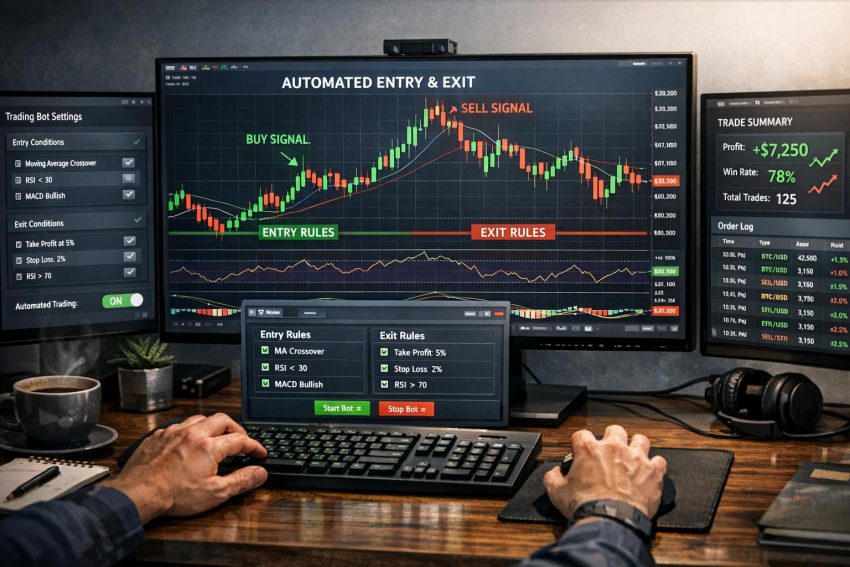
Understanding Automated Entry and Exit Rules in Trading Software
Automated trading software enables market participants to convert structured trading ideas into executable code. Rather than observing charts continuously and manually placing orders, traders can define precise conditions that the platform evaluates in real time. When those conditions are satisfied, the system executes orders according to predefined instructions. At the center of this process are entry and exit rules, which determine when positions are opened, adjusted, and closed.
These rules function as the operational backbone of an automated strategy. Entry rules identify opportunities based on measurable criteria. Exit rules govern risk management, profit realization, and invalidation logic. Without clearly defined parameters for both, automation becomes ineffective or inconsistent. The process of automation requires that every assumption embedded in a discretionary strategy be translated into measurable and programmable conditions.
One of the primary advantages of automated execution is consistency. Decisions are made according to predefined logic rather than interpretation or reaction. This consistency can contribute to disciplined trading practices and more reliable statistical evaluation. However, the effectiveness of automation depends entirely on the clarity, structure, and robustness of the rules embedded within the software.
Translating Trading Concepts into Programmable Logic
Before rules can be automated, they must be expressed in objective terms. Many discretionary strategies rely on qualitative descriptions such as “strong momentum” or “clear reversal pattern.” Automated systems cannot interpret vague expressions. They require quantifiable measurements.
For instance, instead of defining momentum as “strong,” a trader might specify that momentum exists when the price is above a 50-period moving average and the slope of that average is positive for a set number of periods. Each element must be measurable. Conditions must evaluate as either true or false.
This process often reveals hidden ambiguities within a trading plan. Automation forces clarification. If two traders use the same visual chart but interpret signals differently, their discretionary decisions may differ. In contrast, a coded rule produces identical results under identical conditions. Precision is therefore essential not only for execution but also for strategy validation.
The logical structure typically follows conditional sequences. The platform constantly evaluates incoming market data. If specified conditions are met, a signal is generated. Once a signal is confirmed and position sizing is calculated, the system sends an order to the broker. After entry, the software continues monitoring for exit conditions.
Defining Entry Rules for Automation
Entry rules represent the triggering mechanism of an automated system. These rules establish when the probability framework of the strategy justifies exposure to market risk. A properly structured entry condition combines technical or statistical signals into a cohesive framework.
Common automated entry criteria rely on indicators such as moving averages, oscillators, volatility bands, or price breakouts. For example, a trend-following system may initiate a long position when a 20-period moving average crosses above a 100-period moving average. In programmable logic, the condition might require confirmation that the crossover occurred on the current bar and did not exist on the previous bar.
More advanced systems combine multiple filters. A breakout strategy might require price to exceed a defined resistance level while trading volume surpasses its 20-period average. Additional filters could limit trades to certain market sessions or volatility regimes. By layering conditions, the system seeks to reduce low-probability entries.
Automated entry design also includes time-related considerations. Some systems operate only during specified trading hours. Others restrict entries shortly before major economic announcements. These temporal constraints must be encoded precisely, often using timestamps or session definitions within the software.
Indicator-Based Versus Price-Based Entry Models
Indicator-based systems rely on mathematical transformations of price data. Moving averages, Relative Strength Index (RSI), Moving Average Convergence Divergence (MACD), and Bollinger Bands are commonly used in this context. Indicators can simplify complex price behavior into standardized metrics, making them convenient for automation.
Price-based models, by contrast, focus directly on raw price movement. Support and resistance levels, candlestick patterns, and breakout thresholds fall into this category. While they may appear subjective when used manually, they can be quantified for automation. For instance, a support level might be defined as the lowest closing price over the previous 30 periods, and a breakout could require a close above that level by a specific percentage.
Both approaches require accurate parameterization. Period length, threshold values, and confirmation filters influence signal frequency and reliability. Automated systems evaluate these inputs with mathematical precision, so even small parameter adjustments can significantly change strategy behavior.
Parameter Optimization and Data Testing
Before deploying entry rules in live environments, trading platforms typically offer historical backtesting tools. Backtesting applies the defined rules to previous market data to simulate how the strategy would have performed. Metrics such as net return, drawdown, win-to-loss ratio, and trade distribution help evaluate structural integrity.
Optimization features can systematically vary parameters to identify combinations that yield improved historical results. For example, software may test moving average lengths between 10 and 50 periods to determine which configuration produced the highest profit factor.
While optimization tools are valuable, traders must guard against curve fitting. Over-optimization tailors the system to historical conditions that may not persist. A parameter set that performs exceptionally well during a specific historical window may degrade under new market regimes. Robustness testing, including out-of-sample analysis, can help mitigate this limitation.
Structuring Exit Rules for Risk Control and Profit Management
If entry rules determine when exposure begins, exit rules determine how exposure ends. Effective exit design is central to risk management. Even a strategy with a moderate win rate can remain viable if exit logic limits losses and preserves gains.
Stop-loss mechanisms serve as the primary form of capital protection. Automated systems can place stops at fixed distances from entry or at technically derived levels such as recent swing highs or lows. Percentage-based stops align with uniform risk structures, whereas volatility-based stops adapt to changing market conditions.
Profit-taking logic may rely on fixed reward targets, indicator reversals, or time-based closures. A strategy might close trades after a predefined number of bars if momentum fails to extend. Alternatively, it may use trailing stops that adjust upward in long positions as price advances. Trailing mechanisms can be programmed to follow price at a fixed distance or according to volatility measures such as the Average True Range (ATR).
Trade invalidation rules complement stop-loss mechanisms. If the initial rationale for entering a trade disappears, the system exits without waiting for the stop-loss threshold. For example, a breakout system may close a position if price closes back within the original consolidation range. Encoding such logic helps ensure trades remain aligned with strategic intent.
Dynamic Versus Static Exit Structures
Static exit structures use fixed numerical values. A trade may have a stop-loss of 1 percent and a profit target of 2 percent regardless of market volatility. Static structures are simple to code and easy to evaluate.
Dynamic exits adjust to market conditions. An ATR-based stop widens during volatile periods and narrows during quieter conditions. A volatility-adjusted trailing stop can better align with changing price behavior. These adaptive structures often require more complex coding but can enhance long-term stability.
The balance between simplicity and adaptability depends on the trader’s objectives. Highly complex exit logic may introduce additional variables that complicate testing. Simpler designs may offer transparency and easier performance evaluation.
Programming Logic and Order Execution
Automated trading platforms differ in their interfaces. Some provide graphical builders that allow users to assemble strategies using visual components. Others require coding in languages such as Python, C#, or proprietary scripting environments. Regardless of format, the underlying logic must be carefully structured.
A common sequence begins with signal evaluation. The system checks whether entry conditions are met and whether existing positions already exist. It then calculates position size and sends the appropriate order. After execution, it monitors open positions for exit conditions while ensuring compliance with margin and account constraints.
Order type selection influences execution quality. Market orders guarantee execution but do not ensure price. Limit orders specify maximum or minimum acceptable prices but may not be filled. Stop orders activate once price reaches a specified level. Advanced instructions such as stop-limit and trailing stop orders allow more nuanced control.
Automation requires aligning order types with strategic assumptions. A breakout system relying on rapid price movement may require stop orders to ensure participation. A mean-reversion system may prefer limit orders to control entry price.
Position Sizing Integration
Position sizing determines how much capital is allocated to each trade. Automated systems often calculate size based on account equity and predefined risk percentages. If a trader limits risk to 1 percent of total capital per trade, the software divides that amount by the stop-loss distance to compute position size.
This integration ensures risk remains proportional even as account value changes. As capital grows or declines, trade size adjusts automatically. Automated sizing reduces inconsistency and prevents overly concentrated exposure.
More advanced position management may include portfolio-level constraints. Software can limit total exposure across correlated instruments or restrict maximum simultaneous positions. These controls operate alongside entry and exit logic to preserve broader risk stability.
Monitoring and Maintenance of Automated Strategies
Automation does not eliminate oversight responsibilities. Markets evolve, and structural changes may affect strategy performance. Regular monitoring allows traders to evaluate whether results remain consistent with historical expectations.
Performance reviews typically examine drawdown levels, average trade duration, profit factor, and consistency across market conditions. Significant deviations from historical metrics may indicate that market behavior has shifted or that technical issues are present.
Technical maintenance includes verifying data feed accuracy, ensuring reliable connectivity, and confirming platform updates do not alter execution logic. Many traders deploy systems on virtual private servers to maintain continuous operation and minimize latency interruptions.
Forward Testing in Simulated Environments
After completing historical testing, traders often conduct forward testing in simulated accounts. This process exposes the strategy to real-time market data without financial risk. Unlike backtesting, forward testing includes live spreads, potential slippage, and order routing conditions.
Forward observation provides insight into execution nuances that historical simulations may not capture. It also allows traders to confirm that automated logic performs as intended under live market sequencing. Only after satisfactory forward results should capital be committed incrementally.
Risk Considerations and Structural Limitations
Automated systems introduce specific operational risks. Coding errors can cause incorrect trade triggers or unintended order duplication. Even minor logical mistakes, such as misplaced parentheses or incorrect comparison operators, can materially alter outcomes. Thorough validation and incremental testing reduce these risks.
Market conditions may produce execution slippage beyond anticipated levels. During periods of high volatility or low liquidity, stop orders may fill at prices worse than expected. Automation does not eliminate these structural realities.
Dependency on technology also creates exposure to hardware failure, connectivity disruption, or broker outages. Redundant infrastructure and continuous monitoring help mitigate these operational vulnerabilities.
Another limitation involves reliance on historical data. Backtests assume data accuracy and consistent market mechanics. Structural changes in regulation, liquidity, or participant behavior may reduce the relevance of historical patterns. Continuous evaluation is therefore essential.
Regulatory and Broker Constraints
Automated trading must operate within applicable regulatory frameworks. Margin requirements, leverage limits, order frequency restrictions, and reporting standards vary across jurisdictions. Systems must comply with these constraints to avoid disruptions or account limitations.
Broker infrastructure also affects execution performance. Order routing policies, slippage handling, and latency characteristics influence real-world results. Traders designing automation should understand their broker’s execution model and ensure compatibility with strategy requirements.
Comparing Manual and Automated Execution
Manual trading allows discretionary interpretation and contextual flexibility. Traders may evaluate macroeconomic developments or qualitative factors not easily expressed in code. However, discretion can introduce inconsistency in rule application.
Automated execution adheres strictly to predefined conditions. It operates continuously without fatigue or hesitation. This consistency facilitates objective performance analysis. Some traders adopt hybrid models in which software generates signals and humans review them before confirmation. Others rely fully on automation to preserve systematic integrity.
The choice between manual and automated execution depends on experience, strategy structure, and operational preferences. Both approaches require disciplined planning and risk management.
Developing a Structured Automation Workflow
An organized workflow enhances the probability of successful automation. Strategy conceptualization begins with defining objectives and acceptable risk levels. Quantifiable entry and exit rules follow, ensuring each element can be expressed in code.
Historical testing evaluates baseline viability. Parameter adjustments are conducted carefully to maintain robustness. Out-of-sample testing and walk-forward analysis provide additional validation. Forward simulation confirms operational readiness.
Once deployed, the system is monitored regularly. Performance metrics are documented systematically. Adjustments, when required, are implemented methodically rather than reactively. A disciplined workflow reinforces consistency and transparency.
Technology Infrastructure and Security Considerations
Reliable infrastructure underpins automated trading. Continuous connectivity, stable power supply, and low-latency execution channels contribute to operational integrity. Virtual servers often host trading platforms to ensure uninterrupted operation even when personal devices are offline.
Security practices are equally important. Authentication credentials should be encrypted and protected. Access permissions must be controlled carefully. Regular software updates help maintain compatibility and address potential vulnerabilities.
Backup procedures add resilience. Redundant systems, alternative internet connections, and emergency contact protocols with brokers can reduce the impact of unforeseen disruptions.
Conclusion
Automating entry and exit rules transforms trading strategies into systematic, rule-driven processes. By defining precise entry criteria, structuring comprehensive exit logic, and integrating position sizing within software platforms, traders can execute strategies consistently and efficiently.
Successful automation requires explicit rule definition, rigorous historical and forward testing, and continuous monitoring. It does not eliminate market risk or structural uncertainty, but it provides a disciplined framework for managing them. With careful design, reliable infrastructure, and ongoing evaluation, automated entry and exit rules can serve as a foundational component of a structured trading methodology.