
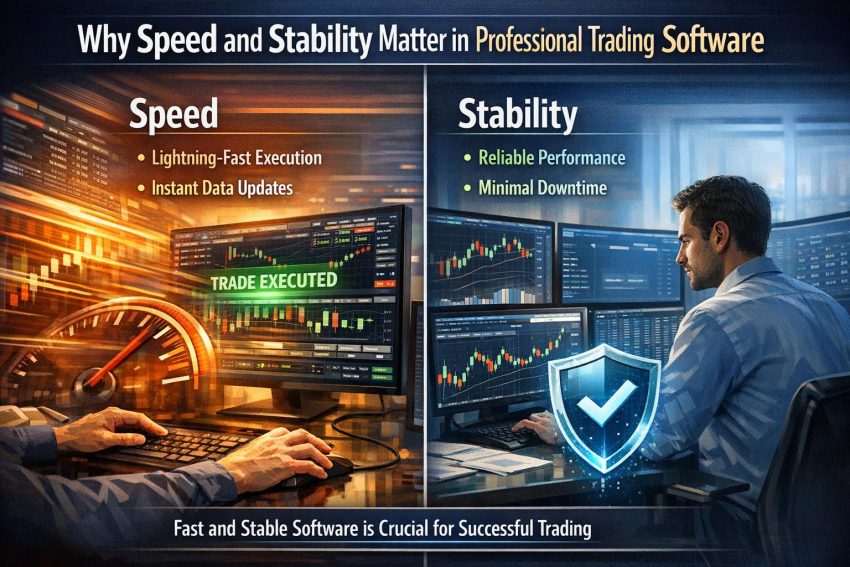
Professional trading operates in an environment where milliseconds influence outcomes and system reliability determines operational continuity. In modern financial markets, the importance of speed and stability in trading software extends beyond convenience; these characteristics are fundamental to execution quality, risk control, regulatory compliance, and competitive positioning. Trading firms, institutional investors, proprietary desks, and even advanced retail traders depend on software infrastructures capable of processing large volumes of market data, executing orders with minimal latency, and operating without interruption. The interaction between system performance and market dynamics explains why technical architecture has become a strategic component of trading success.
The Role of Speed in Order Execution
Speed in trading software primarily refers to low latency in receiving market data, processing that data, generating trade signals, and transmitting orders to exchanges or liquidity providers. Latency is typically measured in milliseconds or microseconds in high-frequency environments. Even modest delays can lead to measurable cost differences because financial markets continuously update prices in response to supply and demand.
When a trading system detects a price opportunity, execution speed determines whether that opportunity can be captured. In highly liquid markets, prices may change multiple times within a single second. A delay of 50 milliseconds can mean that the targeted price level has already shifted. As a result, traders may experience slippage, defined as the difference between the expected execution price and the actual fill price.
For institutional participants executing large orders, the impact of slow systems compounds further. Algorithms designed to slice large trades into smaller pieces rely on precise timing models. If the system introduces delays, the execution algorithm may operate on outdated prices, leading to adverse selection and higher transaction costs. Therefore, speed directly influences trading costs and the quality of fills.
Latency Sources in Trading Systems
Understanding why speed matters requires examining where latency originates. Latency in professional trading software typically arises from several technical layers, including network infrastructure, hardware limitations, software design, and data processing pipelines.
Network latency reflects the physical and routing distance between trading servers and exchange data centers. Data transmitted across fiber optic cables travels at high but finite speeds. Signal routing through switches and routers introduces incremental delays. Many professional firms use colocation services, placing their servers in the same facilities as exchanges to reduce transmission time. In certain strategies, even minor differences in cable length or routing configuration can influence competitive positioning.
Hardware performance also affects processing time. High-performance CPUs with optimized cache architectures reduce computation delays. Advanced network interface cards can process incoming market data packets with lower overhead. Memory configuration influences how rapidly data can be accessed and modified by trading algorithms. In highly latency-sensitive environments, firms implement kernel bypass techniques that allow data to move directly between the network interface and the application, reducing operating system mediation.
Software architecture plays an equally significant role. Event-driven programming models, non-blocking input/output operations, and optimized threading frameworks reduce internal contention and waiting time. Poorly structured code that requires frequent locking of shared resources can create latency spikes. Excessive logging or synchronous database writes within the execution path introduce bottlenecks. Consequently, professional trading software development emphasizes clarity, performance profiling, and careful elimination of unnecessary dependencies.
Market Data Processing and Decision Timing
Professional trading software must ingest and process large volumes of real-time market data, often from multiple venues simultaneously. This includes bid and ask prices, trade prints, order book depth, reference pricing feeds, and sometimes news or alternative data sources. Speed in this context refers not only to how quickly data arrives but also how rapidly it is normalized, validated, and routed to the appropriate strategy components.
Market data feeds typically arrive in compressed or protocol-specific formats. The system must decode these messages, update internal representations of order books, and make the updated state accessible to trading strategies. Every stage introduces potential latency. Efficient data structures designed for rapid insertion, deletion, and lookup are critical for maintaining accuracy without sacrificing speed.
Algorithmic strategies often depend on microstructural signals such as order book imbalances, queue positioning, or short-term volatility estimates. These signals may persist for only brief intervals. If the system processes data too slowly, the strategy effectively operates on stale information. A model that performs well in simulation under assumptions of immediate data availability may underperform in live trading if real-world processing delays degrade timing precision.
Timing precision is particularly important in environments where multiple correlated instruments trade across different venues. Arbitrage strategies frequently compare price relationships between exchanges. If the system updates one venue’s data faster than another, internal state inconsistencies may arise. Therefore, deterministic performance, meaning consistent and predictable processing times, is often more important than occasional bursts of extreme speed.
Order Routing and Execution Infrastructure
Once a trading decision is generated, the order must travel through an execution stack that includes risk checks, order management systems, connectivity gateways, and exchange interfaces. Each layer contributes to total round-trip latency. Streamlining this pathway reduces the time between decision and confirmation.
Professional systems often implement pre-trade risk controls within the execution engine itself to avoid external round trips. Position limits, credit validations, and margin checks must be calculated in microseconds for latency-sensitive strategies. Integrating risk evaluation into the code pathway ensures that compliance requirements do not create separate bottlenecks.
Connectivity to exchanges may utilize specialized protocols such as FIX, binary gateways, or proprietary low-latency interfaces. Binary protocols typically reduce message size and parsing overhead. However, they require careful implementation to prevent data corruption or sequencing errors. Reliability mechanisms such as message acknowledgments and sequence tracking protect against lost or duplicated instructions without significantly increasing latency.
Competitive Dynamics and Market Microstructure
Financial markets function as competitive ecosystems in which participants continuously react to shared information. When multiple firms monitor the same data feeds and deploy similar statistical models, the differentiating factor may be the ability to process and respond marginally faster or more consistently. Even strategies that operate on longer horizons benefit from reduced signaling risk and improved queue placement when execution systems are responsive.
Queue positioning illustrates the importance of speed at a microstructural level. On many exchanges, limit orders are matched according to price-time priority. An order placed earlier at a given price has priority over later orders. Therefore, the difference between submitting an order in 200 microseconds versus 400 microseconds can influence whether the order receives execution before the price changes.
Speed advantages also affect liquidity provision. Market makers continuously update quotes in response to price movements. If updating is delayed, a firm’s quote may remain exposed at an unfavorable price, increasing the likelihood of adverse selection. Thus, speed contributes not only to capturing opportunities but also to limiting risk associated with stale quotes.
The Importance of Stability in Trading Software
While speed drives execution efficiency, stability underpins operational integrity. Stability refers to the ability of trading software to function continuously and predictably under varying load conditions, including periods of heightened volatility. A trading platform that fails during stress events exposes participants to unmanaged risk and potential financial loss.
Market disruptions often coincide with spikes in trading activity. Message traffic can increase severalfold within seconds. Stable systems are engineered with sufficient headroom to accommodate such surges. Capacity planning involves modeling worst-case scenarios, including extreme message rates and simultaneous order bursts. Hardware redundancy and load balancing distribute stress across multiple components to prevent localized failures.
Stability also involves fault tolerance. Software components should isolate failures rather than allowing them to propagate. For example, a failure in a reporting module should not interrupt order execution. Designing systems with clear boundaries and well-defined communication interfaces enhances resilience.
Risk Management and Real-Time Controls
Professional trading firms integrate automated risk management systems directly into trading infrastructure. These systems monitor aggregate positions, instrument-level exposures, market value fluctuations, and counterparty obligations in real time. Stability ensures that these calculations remain synchronized with live trades.
If instability causes temporary desynchronization between executed trades and recorded positions, the firm may operate under incorrect assumptions about exposure. Real-time reconciliation mechanisms cross-verify exchange confirmations with internal records to maintain alignment. Reliable messaging queues and persistent storage reduce the likelihood of data loss during transient disruptions.
Kill switches and circuit breakers serve as protective mechanisms when abnormal patterns are detected. Implementing these safeguards requires stable monitoring frameworks capable of evaluating thresholds continuously. If monitoring services are unreliable, risk controls may trigger too late or fail to activate entirely.
Data Integrity and Auditability
Beyond immediate trading activity, professional systems must preserve accurate historical records. Audit trails detail each order submission, modification, cancellation, and execution. These records support internal analysis, client reporting, and regulatory inquiries.
Data integrity depends on both stable storage systems and precise timestamping. Many jurisdictions require timestamp granularity at the millisecond or microsecond level. Maintaining synchronized clocks across distributed systems involves technologies such as network time protocols and hardware-based time stamping. Drifts or inconsistencies compromise not only compliance but also the internal ability to reconstruct trading events accurately.
Stable logging mechanisms must operate without degrading performance in the execution path. Achieving this balance often requires asynchronous logging architectures in which data is recorded in parallel without blocking active processes.
Infrastructure Redundancy and Disaster Recovery
Modern trading operations implement multi-layered redundancy frameworks. Primary servers are accompanied by secondary systems configured for immediate failover. Geographic distribution reduces exposure to localized disruptions such as power outages or connectivity failures.
Disaster recovery planning extends beyond hardware replication. Data replication must occur continuously to ensure that backup systems reflect current positions and risk states. In some architectures, active-active configurations allow multiple data centers to process trades simultaneously, increasing both capacity and resilience.
Regular testing of failover procedures is essential. Simulated outages verify that automated transitions occur smoothly and that staff members are familiar with escalation protocols. Stability is not a static property but the result of ongoing validation and refinement.
Cloud Computing and Hybrid Architectures
The adoption of cloud infrastructure has introduced new deployment models for trading technology. Cloud platforms provide elastic scalability, enabling firms to adjust computational resources as analytical needs evolve. However, latency-sensitive components often remain in colocated environments due to proximity advantages.
Hybrid architectures separate functions according to sensitivity. Execution engines, pre-trade risk modules, and market data handlers may operate in low-latency environments, while backtesting frameworks, data warehousing, and reporting tools reside in cloud systems. Secure communication channels connect these components, requiring encryption and careful authentication to maintain data confidentiality.
Cloud providers also offer geographic redundancy that complements on-premises resilience strategies. Replicated storage and automated backups contribute to stability, provided that integration is carefully engineered and continuously monitored.
Human Interaction and Interface Responsiveness
Although algorithmic execution dominates many markets, human oversight remains central to governance and strategic adjustment. Trading dashboards must display accurate and timely information regarding positions, profit and loss, and risk metrics. Interface latency, even at a visual refresh level, can influence decision-making.
Stable user interfaces depend on reliable data feeds and responsive rendering engines. If displays freeze or show inconsistent values, operators may misinterpret exposure levels. Clear separation between visualization layers and execution engines prevents graphical slowdowns from impairing core trading functionality.
Training and operational procedures complement technical stability. Clear protocols for system alerts, escalation paths, and manual overrides ensure coordinated responses when irregularities arise.
Operational Monitoring and Continuous Improvement
Professional trading environments implement comprehensive monitoring frameworks that measure latency distributions, throughput rates, error frequencies, and system health indicators. Real-time dashboards allow technical teams to detect anomalies before they escalate into outages.
Performance metrics are analyzed over extended periods to identify trends. Gradual increases in average latency may signal infrastructure aging or growing data volumes. Proactive upgrades prevent degradation from affecting trading outcomes. Root cause analysis following incidents contributes to long-term improvement and institutional learning.
Version control and staged deployment processes further support stability. New code releases undergo simulation testing and limited rollouts before full implementation. This approach allows teams to assess performance impact while minimizing operational disruption.
Balancing Speed and Stability
Speed and stability must be pursued in parallel. Excessive emphasis on micro-optimization without corresponding attention to fault tolerance may produce fragile systems. Conversely, overly complex redundancy frameworks can increase latency and complicate maintenance.
Professional engineering teams focus on efficient design with controlled complexity. Code reviews, automated testing suites, and performance benchmarks establish measurable standards. Clear documentation ensures that optimizations remain understandable to future developers, reducing the probability of unintended side effects.
Hardware upgrades, architectural revisions, and algorithmic enhancements are evaluated not only for performance gains but also for their impact on reliability. Sustainable competitiveness requires maintaining both attributes over evolving market conditions.
Long-Term Strategic Implications
Over extended time horizons, investment in trading technology shapes a firm’s strategic trajectory. Faster and more stable systems allow firms to expand into additional asset classes, engage with new liquidity venues, and support larger trading volumes. Operational credibility strengthens relationships with counterparties and clients.
Regulatory expectations continue to evolve, emphasizing resilience, transparency, and responsible automation. Firms that embed compliance features directly into their software architectures adapt more efficiently to new requirements. Technological flexibility therefore becomes an institutional asset.
Speed and stability are structural pillars of modern trading strategy. They influence transaction costs, risk exposure, compliance posture, and market access. In contemporary markets, strategic insight is expressed through code, and code operates within technological constraints. The firms that treat software performance and reliability as central strategic priorities are positioned to operate effectively in increasingly data-driven and automated financial systems.
Professional trading no longer depends on physical presence on an exchange floor. It depends on optimized networks, precisely engineered applications, and infrastructure designed for resilience. In this environment, speed determines how effectively opportunities are accessed, while stability ensures that participation remains continuous and compliant. Together, these attributes define the operational foundation upon which modern trading performance is built.