
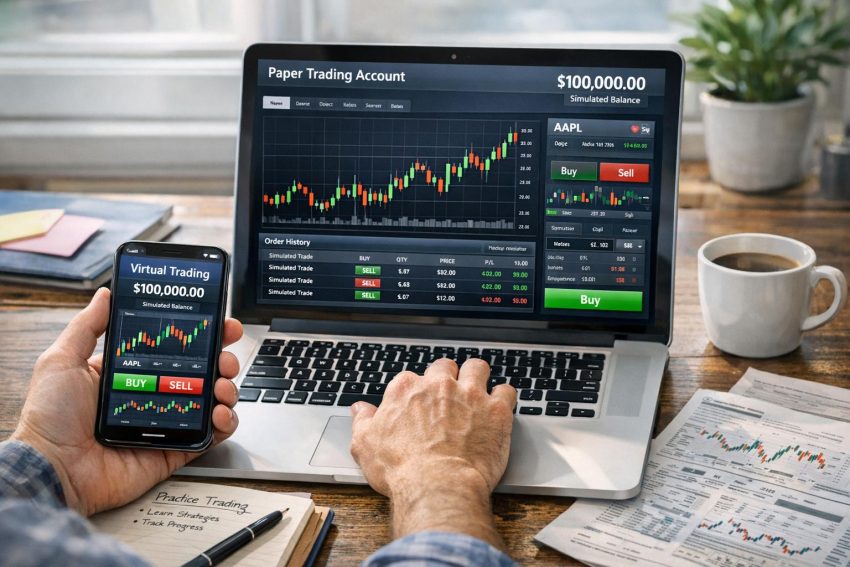
Paper trading software has become an important educational tool for individuals who want to understand financial markets without risking real money. For beginners, the early stages of trading can be costly when mistakes are made using actual capital. Paper trading addresses this risk by simulating real market conditions while using virtual funds. Through these simulated environments, users can learn how markets operate, test strategies, and build confidence before committing their own money.
This article explains how paper trading software works, why it is useful for beginners, and how it supports skill development without financial loss. It also explores the limitations of simulated trading and how new traders can use it effectively.
Understanding Paper Trading Software
Paper trading refers to simulated trading that mirrors real-time financial markets. Historically, traders practiced on paper by recording hypothetical buy and sell decisions in notebooks. They tracked entry prices, exit points, and profit or loss manually. Modern software has replaced this manual process with highly sophisticated digital platforms that replicate nearly every function of a live brokerage account.
Most paper trading platforms offer the same interface as live trading systems. Users can place market orders, limit orders, stop-loss orders, trailing stops, and other advanced order types. Charts update in real time or with slight delays depending on the data feed provided. Watchlists, portfolio summaries, margin calculations, and transaction histories are typically included.
The essential distinction is that no real capital is involved. Transactions are recorded internally within the software rather than sent to an exchange. Profits and losses fluctuate based on market price movements, but they affect only simulated balances.
By providing access to real-time or delayed market data, these platforms allow beginners to observe how asset prices change throughout the trading day. They can monitor how news releases, earnings announcements, interest rate decisions, and geopolitical developments influence price behavior across asset classes.
How Simulated Execution Works
To understand the value of paper trading software, it is important to examine how simulated execution functions. When a trader submits an order in a live environment, the broker routes it to a market venue for execution. The final execution price depends on available liquidity, competition from other orders, and current market conditions.
In a simulated account, the platform processes the order internally. Most systems use the prevailing bid and ask prices to determine a fill. If a user submits a market order, the trade is typically executed immediately at the displayed price. If a limit order is submitted, the system waits until the specified price is reached before executing the trade.
Although these mechanics resemble real trading, execution is often idealized. Slippage may be minimized or absent, and partial fills are less common. Despite these simplifications, the structure remains close enough to reality to provide meaningful learning opportunities.
Learning Market Mechanics Without Financial Risk
Financial markets are built on interconnected mechanisms that may initially appear complex. New traders must understand order matching, spreads, margin requirements, volatility dynamics, and trading hours. Attempting to absorb these components while risking personal capital can create significant stress.
Paper trading allows beginners to observe these mechanics gradually. A user can place a buy order for a publicly traded stock and monitor how the trade appears in the portfolio interface. They can watch unrealized profits fluctuate with minor price movements and observe how commission structures, if simulated, influence net returns.
Through repetition, theoretical knowledge becomes practical understanding. Concepts such as liquidity become clearer when users notice how heavily traded securities tend to execute quickly and closely match quoted prices, while thinly traded assets may move more abruptly.
Because financial loss is not possible in simulation, beginners can focus on comprehension. This separation between learning and financial pressure helps create a more structured educational environment.
Developing Structured Trading Strategies
Successful trading depends on structured planning rather than random decision-making. A trading strategy typically contains defined entry rules, exit conditions, position sizing guidelines, and risk limitations. For beginners, designing such a framework can be challenging.
Paper trading software serves as a laboratory for experimentation. A user might construct a strategy based on technical indicators, such as buying when a short-term moving average crosses above a longer-term average and selling when the reverse occurs. The strategy can be applied across different securities to evaluate consistency.
By documenting each trade and reviewing aggregated results, the beginner starts to see patterns in performance. It becomes possible to quantify win rates, average gains, and average losses. If results are inconsistent or risk exposure appears excessive, the strategy can be adjusted without financial consequence.
Over time, this iterative refinement leads to improved clarity. Rather than relying on isolated trades to assess effectiveness, the trader examines broader statistical trends. This methodical approach forms the foundation of disciplined market participation.
Testing Across Market Conditions
Markets transition through various phases, including expansion, contraction, trend formation, consolidation, and heightened volatility. A strategy that performs adequately in one environment may struggle in another.
Simulated trading accounts allow beginners to test strategies across multiple conditions. For example, during periods of broad market upward movement, long-biased strategies may generate consistent returns. However, when volatility increases or prices move sideways, the same strategy may produce frequent small losses.
Observing these differences helps beginners understand that no single method is universally effective. It reinforces the importance of adaptation and ongoing review. Simulation creates an archive of experience that can be studied when designing future approaches.
Understanding Risk Management in Practice
Risk management is a foundational aspect of trading. Even a strategy with a favorable probability of success can generate large losses if position sizes are excessive. Many beginners initially focus on potential profits rather than potential downside exposure.
Paper trading enables experimentation with position sizing models. A trader might risk a fixed percentage of virtual capital per trade, such as one or two percent. They can compare this disciplined approach with more aggressive allocations and observe the impact on overall equity curves.
If a simulated account experiences a series of consecutive losses, the trader can evaluate how quickly the portfolio declines under different risk models. These observations highlight the importance of drawdown management and capital preservation.
Understanding how small losses compound into larger setbacks provides clarity. When beginners later transition to real money accounts, prior simulated experience often leads to more cautious capital allocation decisions.
Familiarity with Platform Infrastructure
Modern brokerage platforms incorporate numerous tools that extend beyond basic buying and selling. These may include customizable charts, screening functions, depth-of-market displays, options chains, and algorithmic order entry.
For someone unfamiliar with such infrastructure, navigating the interface can be difficult. Paper trading accounts provide unlimited time for exploration. Users can learn how to attach stop-loss orders, adjust take-profit levels, or modify existing trades without fear of error.
Operational mistakes in live markets can be costly. Entering the wrong quantity or misinterpreting order conditions can produce unintended exposure. Repeated practice in a simulated account reduces the likelihood of such errors once live trading begins.
Enhancing Technical and Fundamental Analysis Skills
Analytical ability develops through application rather than passive observation. Paper trading platforms typically integrate charting tools, economic calendars, financial statement summaries, and various technical indicators.
A beginner interested in technical analysis might explore oscillators, momentum indicators, support and resistance levels, and pattern recognition. By placing simulated trades based on specific signals, they can observe whether price movements align with expectations. Over time, they may notice that certain indicators work better under trending conditions than during range-bound markets.
Those inclined toward fundamental analysis can simulate trades based on corporate earnings reports, valuation ratios, or macroeconomic trends. Observing short-term market reactions to fundamental events demonstrates that price action may not always correspond immediately to long-term analysis. This recognition helps refine expectations and reinforces the need for patience.
Exposure to Multiple Asset Classes
Many paper trading platforms provide access to a wide array of instruments, including equities, exchange-traded funds, options, futures, foreign exchange, and digital assets. Each asset class introduces distinct characteristics and risk profiles.
Options, for instance, involve additional variables such as time decay and implied volatility. Futures contracts may require attention to contract expiration dates and margin maintenance. Currency markets operate nearly continuously and are sensitive to macroeconomic releases.
Through simulation, beginners can explore these instruments without financial commitment. They can observe how leverage amplifies both gains and losses in derivatives markets and determine whether such instruments suit their knowledge level and risk tolerance.
Performance Measurement and Record Keeping
Consistent improvement depends on objective evaluation. Many paper trading systems include performance dashboards that summarize metrics such as cumulative return, average holding period, maximum drawdown, and risk-adjusted ratios.
Reviewing these metrics encourages a data-driven perspective. Rather than focusing on individual profitable trades, the beginner assesses overall consistency. If the account experiences frequent large drawdowns despite occasional gains, it indicates structural weaknesses in strategy or risk management.
Maintaining a detailed trading journal alongside platform analytics further enhances learning. Recording the rationale for each trade, emotional state during execution, and post-trade reflections creates a comprehensive feedback loop.
Psychological Conditioning in a Controlled Environment
Emotional discipline is a central challenge in trading. While simulated environments cannot replicate the full intensity of real financial exposure, they still introduce elements of uncertainty and variability.
Users may experience disappointment after a series of simulated losses or premature satisfaction after consecutive gains. Recognizing these reactions in a less pressured environment helps beginners develop awareness of cognitive biases such as overconfidence or loss aversion.
Although financial consequences are absent, structured review of simulated trades encourages rational evaluation. This habit of reviewing evidence rather than reacting impulsively forms a foundation for emotional stability in live markets.
Limitations and Real-World Differences
Despite their educational value, simulated accounts cannot perfectly duplicate live market conditions. Execution quality in paper platforms is typically more favorable than in real trading. Slippage, partial fills, and latency issues may not be fully reflected.
Furthermore, the psychological dimension differs significantly when real capital is involved. Losses in a live account can influence decision-making in ways that simulation cannot fully reproduce. Hesitation to exit losing positions or reluctance to enter valid trades may emerge only when actual money is at stake.
Another limitation involves liquidity in highly volatile markets. During rapid price swings, real orders may execute at levels different from quoted prices. Simulated systems may not always replicate this variability accurately.
Recognizing these limitations prevents unrealistic expectations. Paper trading should be viewed as preparation rather than proof of guaranteed future performance.
Transitioning to Live Trading Gradually
Moving from simulation to real capital requires careful planning. After achieving consistent simulated results over a meaningful period, beginners may consider allocating a modest amount of capital to live markets.
A phased approach is often practical. Traders can continue refining strategies in a paper account while executing smaller positions in a real account. Comparing performances highlights discrepancies between simulated assumptions and actual outcomes.
This gradual transition reduces shock associated with emotional and operational differences. Over time, position sizes can increase as confidence and consistency develop.
Accessibility and Educational Integration
Many brokerage firms offer simulated accounts at no cost. This accessibility broadens participation in financial education. Individuals who might hesitate to open funded accounts can still gain exposure to market dynamics.
Academic institutions frequently integrate paper trading into finance curricula. Students can apply theoretical principles from coursework to dynamic market conditions. Observing real-time pricing behavior reinforces topics such as portfolio diversification, asset correlation, and capital asset pricing models.
Because entry barriers are minimal, paper trading aligns with broader financial literacy objectives. It provides experiential knowledge that complements reading and classroom instruction.
Long-Term Skill Development Through Iteration
Trading proficiency develops incrementally. Mastery requires repeated observation, analysis, correction, and adaptation. Paper trading software supports this iterative cycle by offering a stable and risk-free environment for continuous improvement.
As simulated trades accumulate over months or years, beginners build a dataset reflecting diverse market conditions. Reviewing this dataset uncovers behavioral patterns, recurring errors, and effective tactics. The process resembles professional training simulations used in other complex fields.
By emphasizing structured experimentation and objective evaluation, paper trading transforms abstract interest in markets into measurable skill development. Beginners who approach simulation with discipline and patience are better equipped to navigate the complexities of real-world trading.
In financial markets where errors can have tangible consequences, simulated practice offers a practical pathway to informed participation. Through deliberate use of paper trading software, individuals gain knowledge, technical competence, and risk awareness that serve as the foundation for responsible live trading.