
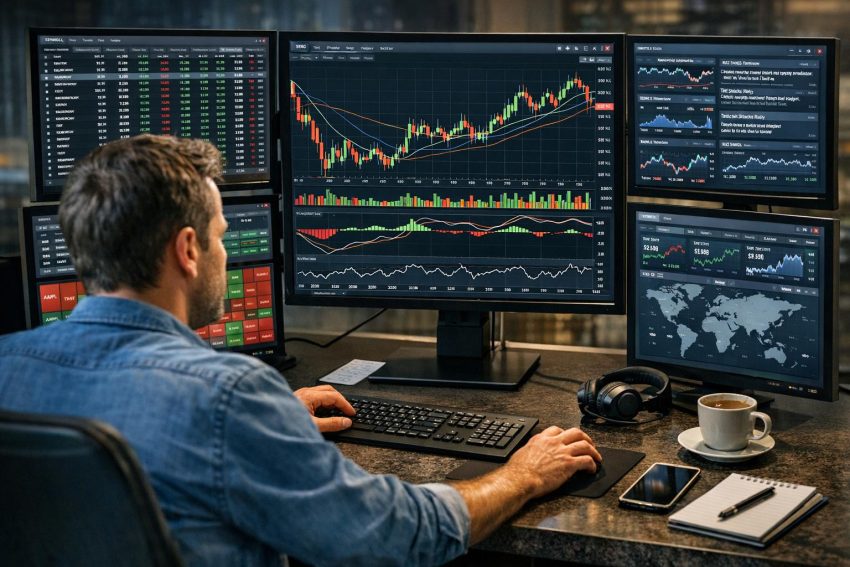
Trading software has become a central tool for market participants who want to identify opportunities across equities, foreign exchange, commodities, cryptocurrencies, and derivatives. Modern platforms combine real-time data feeds, charting tools, automated screeners, and algorithmic features to help traders filter large volumes of market information. Instead of manually reviewing hundreds of charts or financial statements, traders can define specific criteria and allow software to display assets that match those conditions. This process, often referred to as market scanning, improves efficiency and supports more systematic decision-making.
The use of trading software does not eliminate risk or guarantee performance. However, it enables structured analysis, faster reaction to market developments, and consistent application of predefined strategies. Understanding how scanning tools work, how to configure them, and how to interpret their output is essential for using this technology effectively.
The Role of Market Scanning in Trading
Financial markets generate continuous streams of price data, volume figures, and corporate or macroeconomic information. For an active trader, manually processing such data across multiple instruments is not practical. Scanning tools address this challenge by filtering assets according to technical, fundamental, or quantitative conditions.
For example, a trader may want to identify stocks trading above their 50-day moving average while simultaneously experiencing higher-than-average trading volume. Without software, this would require reviewing each chart individually. With a scanner, the trader can define the conditions once and receive an updated list of qualifying securities within seconds. The ability to automate repetitive review tasks allows the trader to concentrate on evaluating trade quality rather than gathering raw data.
In this context, scanning software serves three primary functions: data aggregation, criteria filtering, and alert generation. Data aggregation collects information from exchanges and data providers. Criteria filtering narrows the universe of tradable instruments based on predefined rules. Alert generation notifies the user when new instruments meet those conditions. Together, these functions create a structured environment for opportunity discovery.
Core Components of Trading Software
Most professional and retail trading platforms share common structural components. Understanding these elements improves the trader’s ability to configure scanners effectively and interpret results within the appropriate technical and operational context.
Market Data Feeds
Scanning accuracy depends on reliable data. Trading software connects to data feeds that deliver price quotes, bid-ask spreads, volume updates, order book information, and sometimes fundamental metrics. Depending on the subscription level, feeds may provide delayed or real-time data. Day traders typically require real-time data, while longer-term investors may use end-of-day information.
Latency, data completeness, and exchange coverage matter significantly. In fast-moving markets such as foreign exchange or cryptocurrency, even small delays can affect the relevance of scan results. Institutional-grade platforms often prioritize low-latency infrastructure, while retail traders balance cost considerations against the need for speed.
Charting and Technical Indicators
Charting modules allow visualization of historical and current price action. Indicators such as moving averages, relative strength index (RSI), Bollinger Bands, average true range (ATR), and MACD are often integrated directly into the system. Scanners can apply these indicators quantitatively. For example, the condition RSI below 30 may signal potential oversold conditions within a defined time frame.
Beyond standard indicators, some platforms allow custom overlays, drawing tools, and pattern recognition modules. Automated candlestick detection or support and resistance algorithms can feed into scanning conditions. This integration ensures that technical logic used in discretionary chart analysis can be adapted into objective scanning rules.
Fundamental Data Modules
In equity markets, many traders incorporate financial metrics such as earnings growth, price-to-earnings ratios, dividend yields, free cash flow, or revenue trends. Fundamental scanning tools filter companies according to these metrics. This approach is common among swing traders and position traders who align technical signals with underlying financial strength.
Data normalization is an important factor. Financial reporting standards may differ across jurisdictions, and software providers often standardize metrics to maintain comparability. Traders using international equity scanners should verify that definitions and accounting treatments align with their analytical assumptions.
Order Execution Systems
Although scanning focuses on identification, integration with execution systems allows traders to move from analysis to action efficiently. Some platforms support one-click trading or algorithmic execution directly from scanner results, reducing latency between discovery and implementation.
Execution modules typically include order types such as market, limit, stop, and conditional orders. Advanced systems allow bracket orders that combine entry, stop-loss, and take-profit instructions. Linking these tools to scan outputs reduces operational friction and helps enforce predefined trade management rules.
Types of Market Scans
Market scans can be categorized according to the type of criteria used. While many strategies combine multiple methods, distinguishing among them clarifies their specific purposes and operational characteristics.
Technical Scans
Technical scans rely primarily on price and volume data. Traders can configure conditions based on trend direction, breakout levels, volatility contractions, or momentum acceleration. For instance, a breakout scan might search for securities making a new 20-day high with volume exceeding the 30-day average. Momentum-focused traders may scan for assets with a strong upward price slope over several sessions.
Volatility-based scans may use measures such as ATR compression to identify potential expansion phases. Mean-reversion traders might look for securities deviating a defined percentage from a moving average. These scans are often time-sensitive and may run intraday at frequent intervals. During volatile periods, traders may shorten time frames or introduce additional confirmation filters to refine outputs.
Fundamental Scans
Fundamental scans filter securities based on financial performance metrics. A trader might look for companies with quarterly earnings growth above a defined percentage and manageable debt-to-equity ratios. Screens may also include return on equity thresholds or expanding operating margins.
Unlike intraday technical signals, fundamental factors change less frequently. As a result, these scans are often run weekly, monthly, or after corporate earnings announcements. The objective is to create a universe of financially robust securities, which can then be monitored for technical entry signals.
Macro and Cross-Asset Scans
In foreign exchange and commodity markets, macroeconomic variables play a larger role. Some platforms allow scanning currency pairs based on interest rate differentials, correlation patterns, or relative strength against a currency index. Commodity traders may filter instruments based on seasonal tendencies combined with price structure.
Cross-asset scanners examine relationships between different markets. For example, a trader might scan for equities outperforming a benchmark index while bond yields decline, suggesting a potential sector rotation. These approaches require integrated data feeds and more complex condition building.
Quantitative and Custom Formula Scans
Some platforms support the creation of custom formulas using built-in scripting languages. These formulas combine technical and fundamental variables into composite conditions. For example, a trader might define a proprietary score that incorporates momentum ranking, volatility contraction, and revenue acceleration. When the combined score reaches a threshold, the instrument appears in results.
This customization supports systematic and rule-driven strategies. In institutional settings, quantitative analysts often validate these formulas across historical datasets before deploying them in live trading environments. The objective is to ensure that signal logic reflects repeatable market characteristics rather than isolated historical patterns.
Configuring Effective Scan Criteria
The quality of scan results depends directly on the clarity of the underlying trading strategy. Without clearly defined rules, scanning may produce excessive or irrelevant output. Translating conceptual setups into precise mathematical conditions is therefore essential.
For example, instead of searching for “strong stocks,” a more objective rule might define strength as a 15% price appreciation over the past 40 sessions, combined with a relative strength ranking above a specified percentile. By formalizing definitions, the trader creates repeatable results and minimizes subjective interpretation.
Threshold calibration influences signal frequency. Narrow conditions produce fewer results but may increase selectivity. Broader filters create larger candidate lists that require secondary evaluation. Traders often iterate parameters using sample periods to observe how adjustments affect output volume and composition.
Time Frames and Multi-Timeframe Analysis
Scanning can be applied across multiple time frames, from one-minute intervals to monthly charts. Day traders often focus on intraday consolidation patterns, opening range breakouts, or volume spikes. Swing traders may scan daily charts for retracements within broader weekly uptrends.
Advanced platforms support multi-timeframe logic. A scan might require that a weekly chart displays an upward trend based on moving average alignment, while the daily chart shows a pullback toward support with declining volume. This structure helps align short-term entries with broader market direction.
Multi-timeframe filters can reduce false positives but also narrow the opportunity set. Balancing selectivity with trade frequency requires ongoing monitoring and periodic reassessment of scan performance.
Backtesting and Validation
Before applying a scanning strategy in live markets, many traders validate conditions using historical simulation. Backtesting applies predefined criteria to past market data to evaluate how often signals occurred and how assets performed subsequently.
Evaluation metrics often include win ratio, average gain and loss, maximum drawdown, profit factor, and risk-adjusted return measures. Consistency across different market regimes increases confidence in rule robustness. Testing across bull, bear, and range-bound periods helps determine sensitivity to market cycles.
It is important to avoid excessive parameter optimization. Overfitting occurs when rules are adjusted specifically to match historical price movements, reducing predictive reliability. Maintaining moderate rule complexity and testing across out-of-sample periods can help mitigate this issue.
Real-Time Alerts and Automation
Scanning becomes more practical when integrated with alert systems. Traders can configure notifications through platform interfaces, mobile applications, or desktop alerts. Real-time monitoring allows traders to respond promptly without manually re-running scans throughout the session.
Automation extends this process further. In algorithmic environments, once conditions are satisfied, predetermined orders execute automatically according to risk parameters. Automation reduces reaction latency and enforces consistency. However, it requires careful infrastructure stability, monitoring protocols, and contingency safeguards.
Many traders adopt a hybrid model in which scanners generate alerts, but final order placement remains discretionary. This structure retains human oversight while preserving efficiency.
Risk Management Integration
Scanning identifies opportunities, but risk management determines long-term sustainability. Some platforms integrate risk calculation tools directly within scan results. Traders can estimate position size based on account equity, acceptable risk percentage, and stop-loss distance.
Linking scanner outputs with predefined risk constraints standardizes capital exposure. For example, if the strategy specifies a maximum 1% capital risk per trade, the software can automatically calculate position size once entry and stop levels are defined. This connection between identification and risk control reduces inconsistency.
Portfolio-level risk considerations can also be integrated. Traders may limit exposure by sector, asset class, or correlation cluster. Certain scanners allow filtering assets that exceed existing portfolio concentration thresholds.
Workflow Integration and Operational Structure
Effective scanning requires structured workflow integration. Many market participants schedule scans during pre-market preparation to identify candidates before the opening bell. Intraday scans may run automatically at predetermined intervals. End-of-day reviews help capture setups for swing or position trades.
Documented procedures support consistency. Traders often maintain written criteria definitions, record parameter updates, and log historical signal frequency. This documentation provides context when adjusting strategies due to changing volatility or liquidity conditions.
Watchlist management complements scanning. Instruments identified through filters can be grouped according to strategy type, sector, or timeframe. Active monitoring lists may differ from broader research universes developed from fundamental screens.
Platform Selection Considerations
Selecting appropriate trading software depends on trading horizon, asset coverage, and analytical requirements. High-frequency participants typically require low-latency connectivity and stable execution architecture. Investors focusing on equities may prioritize comprehensive financial databases and earnings calendar integration.
Cost structures vary. Some platforms operate via monthly subscriptions that include real-time data packages. Others integrate scanning features into brokerage accounts with tiered data pricing. Evaluating total cost relative to trade frequency and expected capital allocation is part of strategic planning.
User interface design influences operational accuracy. Clear condition builders, visual previews of filter logic, and intuitive parameter selection reduce mistakes. Traders utilizing scripting features should assess documentation quality and community support resources before committing to a specific platform.
Limitations and Practical Constraints
Despite efficiency improvements, scanning software has inherent limitations. It relies on numeric inputs derived from historical or real-time data, which may not immediately capture qualitative developments such as regulatory investigations, executive leadership changes, or geopolitical escalation.
Market regime shifts may alter indicator behavior. A momentum strategy that produced frequent signals during trending periods might generate limited results in range-bound conditions. Continuous performance monitoring is necessary to ensure that scanning rules remain aligned with prevailing dynamics.
Data quality issues can also affect outcomes. Corporate actions such as stock splits or dividend adjustments must be correctly reflected in historical price series. Inaccurate data feeds may distort indicator calculations and produce misleading outputs.
Conclusion
Using trading software to scan markets enables systematic identification of opportunities across multiple financial instruments. By translating strategy concepts into measurable criteria, traders can filter extensive data streams and maintain consistency in analysis. Technical, fundamental, macro, and quantitative scans each serve distinct analytical purposes, and their effectiveness depends on thoughtful configuration and ongoing validation.
While scanning tools expand analytical capacity and improve operational efficiency, they remain support mechanisms rather than performance guarantees. External events, liquidity constraints, and evolving market structures continue to influence trade outcomes. Traders who combine clearly defined scanning parameters with disciplined risk management and structured workflow practices are better positioned to use software as a functional extension of their analytical process.